
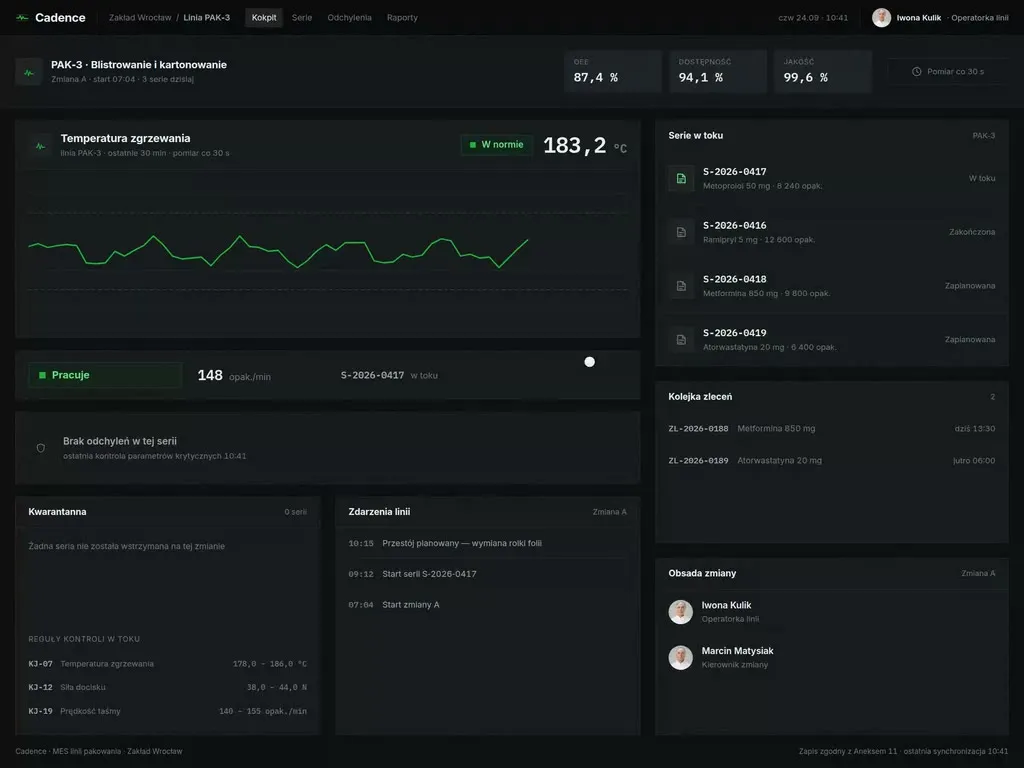

Telecommunications
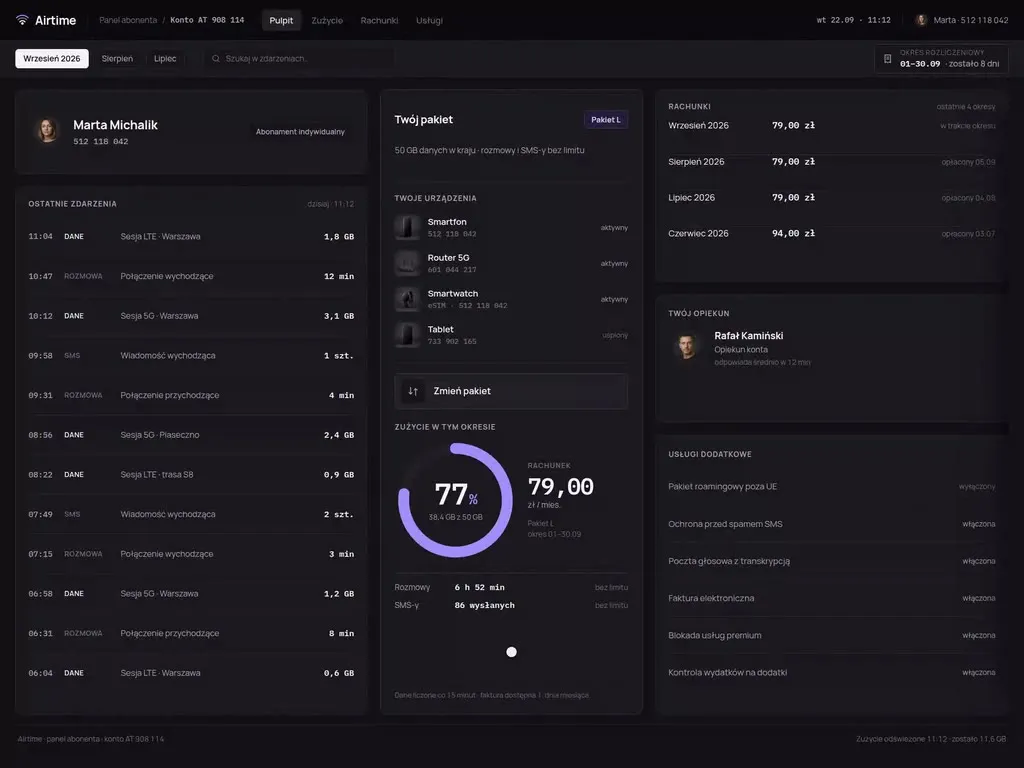
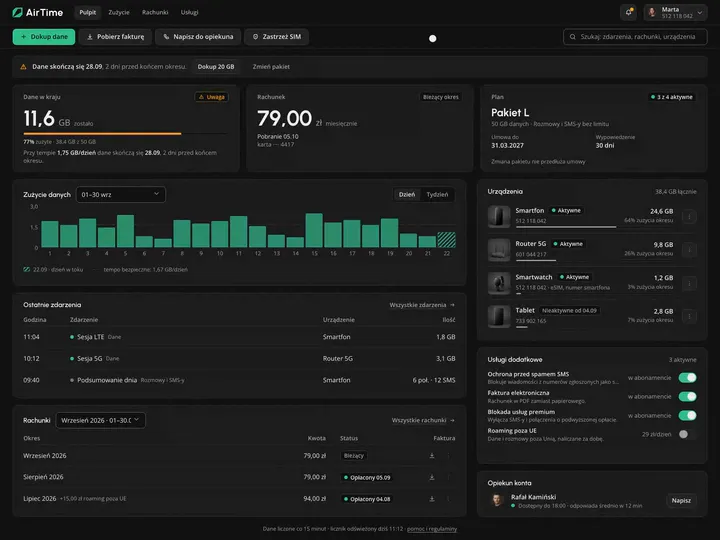
At Wzór UX agency you receive an interactive design of your telecommunications software, be it a subscriber self-care app, an online store with number porting or an in-store sales system, and either our team or your own developers can then build it. That is how Airtime came about, a mobile operator subscriber panel that works out from the rate of use when the data in the plan will run out.







Challenges
What challenges do we help solve in telecommunications?
Our approach
In designing the online store of an operator, we place number porting as a single step with a calendar: the customer picks a day and sees next to it how long their current SIM keeps working and when the new one arrives. The store advisor and the helpline consultant later see the same day, so a customer who calls to ask about their number hears the same date.
Scope of services
Our approach
We design the advisor's workstation around the customer at the counter, not around the systems: the numbers, contracts and devices on one account sit on one screen. The advisor answers the customer's question without opening another window, and any change they make goes straight into the right system.
Scope of services
Our approach
When designing a technician app, we give the technician two answers before setting off: whether the customer confirmed the appointment the day before and whether the building already has a connection. The technician moves a job that cannot be finished today to a new slot from the phone, without calling the dispatcher.
Scope of services
Who it is for
Which telecommunications companies do we design software for?
Subscriber self-care apps
Mobile operators and internet providers whose subscribers pay, buy extra data and change services in a self-care app. Airtime, a mobile operator subscriber panel, is laid out for an account with several devices: a smartphone, a 5G router, a smartwatch with an eSIM and a tablet sit on one list, each with its own data usage.
Operator online stores
Operators that sell a plan together with a phone in instalments online and, for home internet, first check whether the service is available at the customer's address. When designing an operator's online store, we put the address check before the choice of package, so nobody picks an offer that cannot be switched on at their address.
In-store sales and service systems
Operator stores where an advisor at the counter registers prepaid SIM cards, sets up customers' phones and handles their everyday matters. In designing an in-store workstation, we add a second display at the counter. On it the shopper sees what the advisor sees: the chosen offer and the documents, before signing them.
Technician apps and service jobs
Fibre network operators and installation companies where a technician drives from address to address for the whole shift and gets jobs on the phone from the OSS. When we design a technician app, we also plan for jobs without signal, in a basement or on a staircase. The task list, photos of the finished installation and the customer's signature then stay on the phone until the technician is back in range.
Business customer portals
Operators with business customers, where an account administrator on the company side orders SIM cards for new staff, blocks the cards of people who leave and sets limits. When designing a business customer portal, we give the manager approval of orders over the cost limit. The administrator then changes many cards in one action.

Why us?
Why choose our UX agency?
-
Fewer complaints after a plan change
A subscriber who sees, before confirming a plan change, from which day the new amount applies and whether the change extends the contract does not dispute the bill later out of surprise. The complaints team deals with matters no screen will explain.
-
Add-on services without a consultant
Subscribers order premium service blocking or SMS spam protection themselves in the app. Consultants no longer take such requests over the phone, and the operator sells these services at any hour.
-
Advisors up to speed sooner
A new advisor whose screen suggests the next step in every matter serves customers without an older colleague's help sooner. The store network loses less when the staff changes.
-
A senior team
A team of senior UX designers who have been designing interfaces for nine years, today for large organisations, SaaS companies and software houses.
-
Proven client trust
We have designed for 115 brands, and most of them come back to us with their next project.
-
Higher quality with AI
A designer with AI tools checks more variants of an order screen or an advisor workstation than they could draw by hand and picks the one that works. What reaches you is a tested version, not the first one that came out.
Process
How will we design your telecommunications system, step by step?
-
A conversation with your team

We set the goals and look at the channels where you sell to and serve subscribers
We sit down with the people responsible for online sales, the store network, customer service and field technicians. We choose the channel we start with, list the systems an order and a fault report pass through and agree how you will know the project has worked.
Key steps
- Conversations with the heads of sales, stores, customer service and field operations
- A review of systems: BSS, OSS, CRM, online store, subscriber app
- Choosing the channel we start with
- Agreeing the measures: abandoned orders, handling time in store, technician visits without an installation
Deliverables
- Project brief
- Map of systems and sales channels
- List of measures
- Scope of the first stage
-
Discovery in the store, on the helpline and at the customer's
We watch the work at the counter, on the phone and at the installation address
We stand next to an advisor in a store at the busiest hours, listen to helpline calls about number porting and go with a technician to a fibre installation. We note the workarounds: a sticky note with passwords to several systems at the counter, a screenshot sent to a technician over a messenger app, a consultant's note typed into a field meant for something else.
Key steps
- Observing an advisor's work in the store
- Listening to helpline calls
- Going out with a technician to an installation
- Order tests with customers on their own phones
- A review of app reviews in the app stores
Deliverables
- Research report
- Map of the work, showing where people work around the system
- Prioritised list of problems
-
Interactive system design
A design that advisors, technicians and subscribers click through
Advisors test the prototype at the counter on sample cases, technicians on a phone in the field and subscribers on their own smartphones. Feedback reaches the design before the developers take it over.
Key steps
- Screen architecture by role: subscriber, store customer, advisor, technician, business account administrator
- Interactive design on your offer and price list
- Exception states: a rejected porting request, no connection in the building, a SIM blocked after a lost phone
- Prototype tests with advisors, technicians and subscribers
Deliverables
- Interactive design of every screen
- Component library
- Description of behaviour in exceptions
- Prototype test report
-
Build or design hand-off
The new screens reach your channels together with the integrations
Our team builds the design, or we hand it over to your developers or your BSS vendor. Either way, we spell out where each screen takes its data from: the BSS, the OSS, the CRM or the ticketing system, so that a change in the store does not hold up service activation.
Key steps
- Screen and field specification for developers
- Integration map: BSS, OSS, CRM, ticketing system, payments and instalments, number porting through PLI CBD
- Support for the implementation team
- Tests on test accounts before launch
Deliverables
- A working system or a package ready to build
- Integration specification
- Pre-launch test report
-
Measuring after launch
We check against sales and service data whether the change worked
After launch we compare abandoned orders, handling time in store and technician visits without an installation with the measurement taken before the change. We go through the results with advisors and technicians, and then together we decide what to improve next.
Key steps
- Measuring abandoned orders in the online store
- Customer handling time in store
- A review of jobs closed without an installation
- Plan for the next improvements
Deliverables
- Measurement report
- Prioritised list of improvements
- System development plan
Methods and technologies
Systems and standards we work with in telecommunications
-
BSS
When an operator's sales run on a BSS, from Amdocs or Ericsson for example, the online store and the stores learn from the BSS which new offers a given customer is eligible for. In designing sales and service screens on such a BSS, we present an offer that is not available under a given contract together with the reason, rather than hiding it without a word.
-
OSS
When we design the order screens, we spell out as successive steps the path an order takes from the BSS to the OSS, from placing it to service activation. The BSS passes the customer's order on to the OSS for technical activation, such as provisioning a SIM card.
-
PLI CBD
When designing sales screens for number porting, we turn the messages providers exchange through PLI CBD into sentences about what is happening to the number being ported. PLI CBD is an IT system managed by the President of UKE, the Polish telecoms regulator, and providers use it to exchange information on number porting requests electronically.
-
eSIM
In an eSIM swap code screen we design, we show until the switch when the old card will stop working and what to do if the customer did not request the swap. In Play's guide the swap works like this: it is requested in a store, the QR code arrives by email, and 3 hours after the request the physical card stops working.
-
TM Forum Open API
In an online store, in-store workstation and partner panel we design on a BSS that exposes TM Forum Open APIs, we base all three on one catalogue, so a partner's offer does not drift away from the one sold online. These open interfaces for operators include TMF622 for orders and TMF620 for the product catalogue, through which an operator feeds partners the technical description of its products.
-
Poland's act on accessibility of products and services
Poland's act implementing the European Accessibility Act covers telecommunications services offered or provided to consumers, with the exception of transmission services used for machine-to-machine communication services and services offered or provided by microenterprises. When designing subscriber apps, we go through every journey that can be handled on the helpline today with a screen reader and the keyboard alone.
Selected work
Our work in related fields
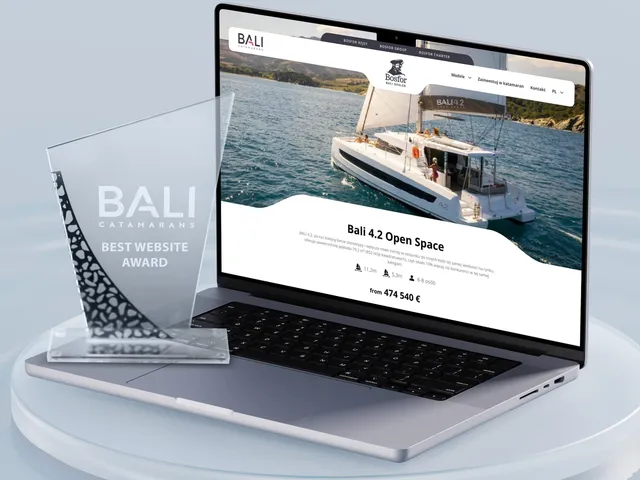
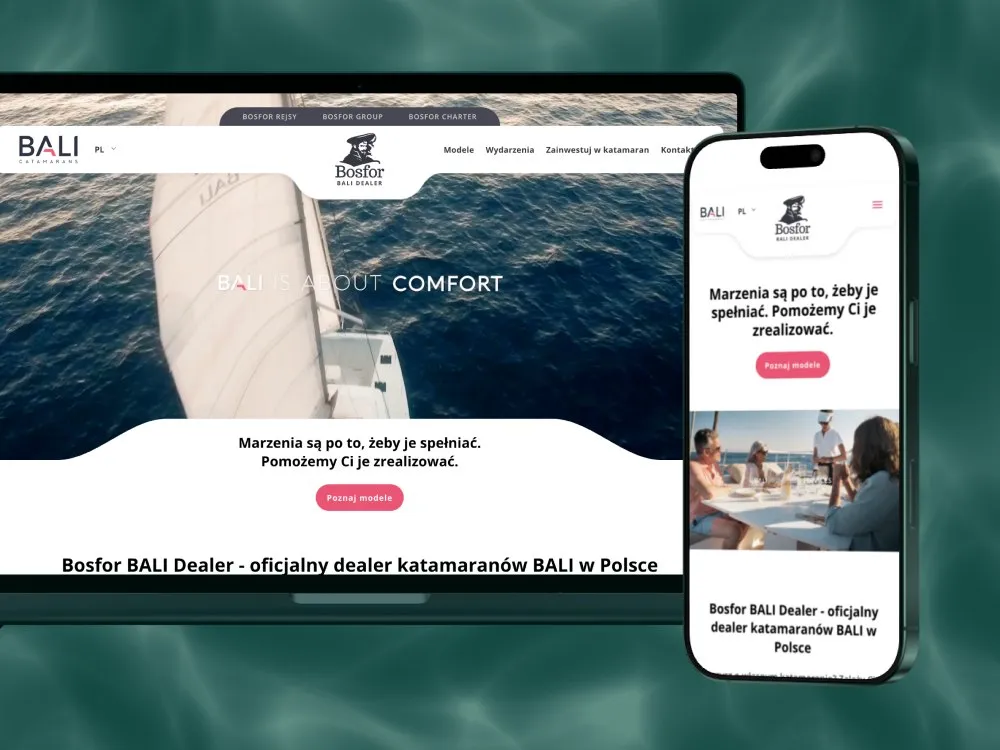
Our portfolio does not yet include a project for a mobile operator or an internet provider. Below are projects that have services as one of their industries: a website with a product catalogue, a cashless tipping platform with a customer panel and a catamaran dealer's website, whose leading industries are manufacturing, banking and finance, and transport and travel respectively.
-
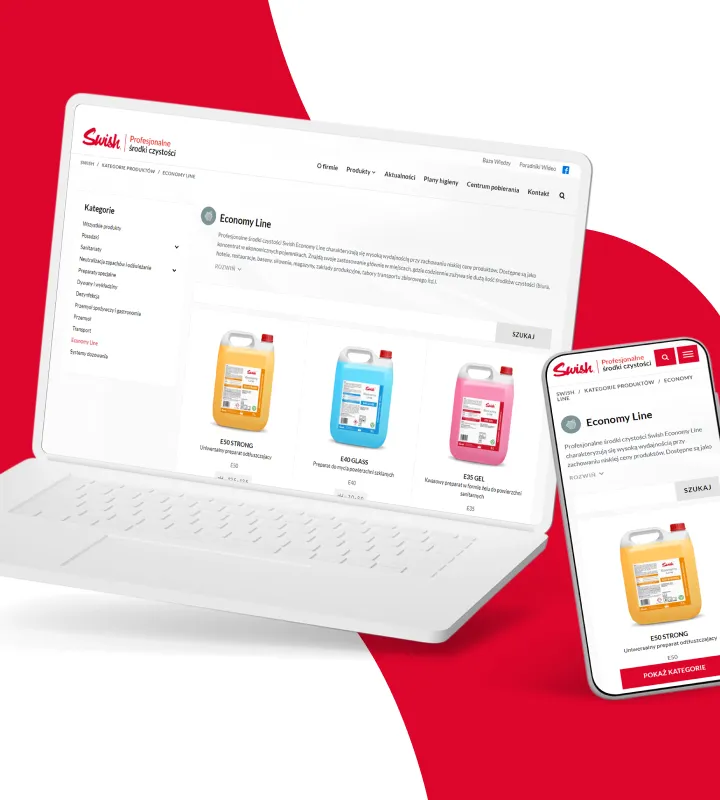
Industrial Manufacturing
Swish
Read case studyWe delivered the UX/UI design for Swish's online product catalogue, focusing on process automation and a no-code WordPress implementation.
-
Banking & Finance
Tip Card
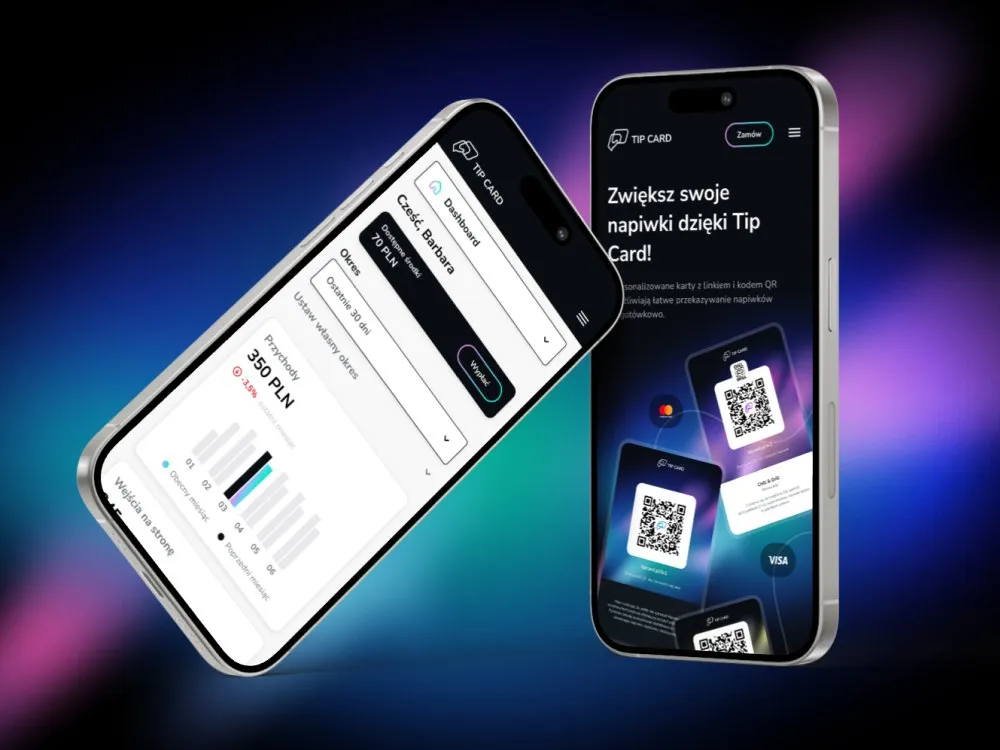
View projectTip Card - a cashless tipping platform based on personalised QR-code cards. A "Boost your tips with Tip Card!" landing page, a card store, sign-up and a client panel with earnings, transactions and payouts. A dark, colourful layout, desktop and mobile.
-
Bosfor BALI Dealer
Website for a BALI catamaran dealer
- See what else we build Projects
Start your telecommunications software project
One team designs your subscriber app, online store, in-store workstation, technician app and business portal, from research at the counter to the build.
Client voices
What our clients say
 Maja Wieloch-Silecka Operations Director, Bosfor Group

“Working with the Wzór team was a genuinely great experience! They always answered our questions quickly and were flexible about our comments. They have no shortage of creative ideas and are at the same time thoroughly reliable and on time. The end result fully met our expectations; we recommend them to anyone looking for professionals who care.”
 Piotr Alberski Chief Operating Officer, Agencja XO Media

“Our clients expect us to act fast and effectively across a very wide scope - from building a brand, through a website with a store, to running an effective sales campaign. Not an easy task, but doable when you have a tight-knit team and partners who take on challenges on the fly. For us, quality, accountability and commitment are key, and working with UX Agency Wzór gives us that 100%.”
 Mateusz Swół Chief Operating Officer, Sellace

“Our cooperation with UX Agency Wzór started with our own website. We really liked the way they work, so we decided to subcontract projects for our clients to them on a White Label basis. We loved their workflow, the way they hand projects over to our team, their documentation and their work on the design system. Now we can take on bigger risks.”



























The team
Who will design your telecommunications system?
-

Aleksandra Bondar
Senior UX/UI Designer
View profileHow can I help you?
“I will design the order for a plan with a phone in instalments so that, before paying, the customer sees in one place the phone instalment and the plan fee for every month of the contract.”
-

Katarzyna Adamczuk
Prezes, Analityk Biznesowy
View profileHow can I help you?
“I will map out with you who changes the offer, who approves it for stores and partners, and when the advisors hear about it.”
-
Patryk Korycki
CEO, Analityk Biznesowy
View profileHow can I help you?
“I will agree the scope and budget with you, and during the build I will keep an eye on deadlines on the BSS vendor's side.”
-

Tadek Wadas
Senior UX/UI Designer
View profileHow can I help you?
“I will test the technician app with installers in the field, and the store workstation with advisors at the busiest hours.”
FAQ
Frequently asked questions about telecommunications software
What is a self-care app?
A self-care app is an operator's app or portal where subscribers handle matters of their account and services themselves, without talking to a consultant. When designing such an app, we separate what the account owner sees from what a user of a number not registered to them sees. Such an app is also increasingly subscribers' first stop when they have a technical problem.
What is the difference between BSS and OSS?
The BSS runs the business side of an operator: billing, CRM, order management and revenue tracking, while the OSS runs the technical side: network planning, monitoring, maintenance, fault management and service delivery. In every screen we design, we establish which of these systems each field comes from. Business specialists, sales teams and customer service work in the BSS, and developers and network engineers in the OSS.
How do you port a number to another network?
To port a number to another network, the subscriber concludes a contract with number porting with the new provider, and the new provider leads the porting process. The subscriber chooses the mode: keeping the notice period of the current contract, without it on a specific date, or at the end of the period required for promotional terms. Under Poland's Electronic Communications Law, porting takes place no later than one working day after the day agreed with the subscriber on which the new provider starts the service. Providers charge the subscriber nothing for the porting itself. If, however, the subscriber terminates the current contract without keeping to the notice periods, they pay the current provider a fee no higher than the subscription for the notice period, and at most for one billing period. Where the contract was concluded for a fixed term that has not yet ended, the provider may add compensation to that fee. The law does not give the right to port a number between a fixed and a mobile network.
Does an operator have to tell you when your data runs out?
Yes, when internet access is billed on the basis of time or the volume of data used. The provider of such a service notifies the consumer that the limit in their plan is about to be reached before it is reached, and that it has been used up immediately after that happens. The same provision of Poland's Electronic Communications Law requires such a provider to offer a tool for monitoring and controlling usage, with access to up-to-date information, where on a fixed network information on usage from no more than 48 hours earlier counts as up to date. When designing a subscriber app, we link that notification to the screen for buying data and changing plans, so nobody has to look for it.
What is a contract summary?
A contract summary is a concise and easily readable summary of the main pre-contractual information that a provider of electronic communications services delivers to the consumer free of charge on a durable medium before the contract is concluded. The obligation does not apply to data transmission services in machine-to-machine communication. It includes in particular the provider's contact details, the main features of the services, the price of the service including the activation price and the subscription or other periodic fee, the contract period with the conditions for its renewal and termination, and information on facilities for people with disabilities. When we design an online store, we place the order button after the summary, not next to it. Where objective technical reasons make it impossible to provide the summary before the contract is concluded, the provider provides it without delay, and the consumer's declaration concluding the contract takes effect once it has been confirmed after receiving the summary.
How long can a contract with an operator last?
A consumer's fixed-term contract for telecommunications services may last no longer than 24 months. The provider of telecommunications services must also offer the option of concluding such a contract for a period of no more than 12 months. In designing an offer configurator, we put the contract length in the same step as choosing a package, not at the very end. The limits do not cover data transmission services in machine-to-machine communication.
What is CRM in telecommunications?
CRM in telecommunications is the system in which an operator records every interaction with a subscriber: account creation, order history, service configuration, billing enquiries and support tickets. Unlike a generic CRM, it connects to the systems for service activation, network inventory and rating, so the service team sees the current state of the customer's services. In designing such a CRM, we give advisors in stores and consultants on the helpline separate views, because the first have the customer in front of them and the second only their voice.
What is an MVNO?
An MVNO is a mobile virtual network operator that deals directly with customers but relies on an operator that owns a network (an MNO) for network access. When designing a subscriber app for an MVNO, we start with the list of network data the MVNO receives from the network owner, because what users see depends on it. An MVNO may use its own OSS tools or those provided by its host operator.
How do you report a suspicious text message?
In Poland a suspicious text message is forwarded to the number 8080, where CSIRT NASK takes reports of messages suspected of smishing, meaning a sender impersonating another party, for example to get the recipient to hand over personal data or open a website. The operator lets its users use this number free of charge. CSIRT NASK monitors smishing based on such messages and information from operators and uses the results to create message patterns. An operator that receives a pattern blocks text messages whose content matches it.
Related services
Services related to telecommunications software
Your app's ratings in the app stores are falling, and you do not know which screen is dragging them down.
First we will go through the app with users on their own phones and point out where to start.
You are moving to a new BSS, and the online store, the stores and customer service have to change with it.
We will check with the people at the counter and with customers what works today, so the migration does not lose it.
The tools for subscribers, advisors and technicians were built separately, and each calls the same services by different names.
We will design a shared set of components and names for every channel.