

Automotive & Mobility
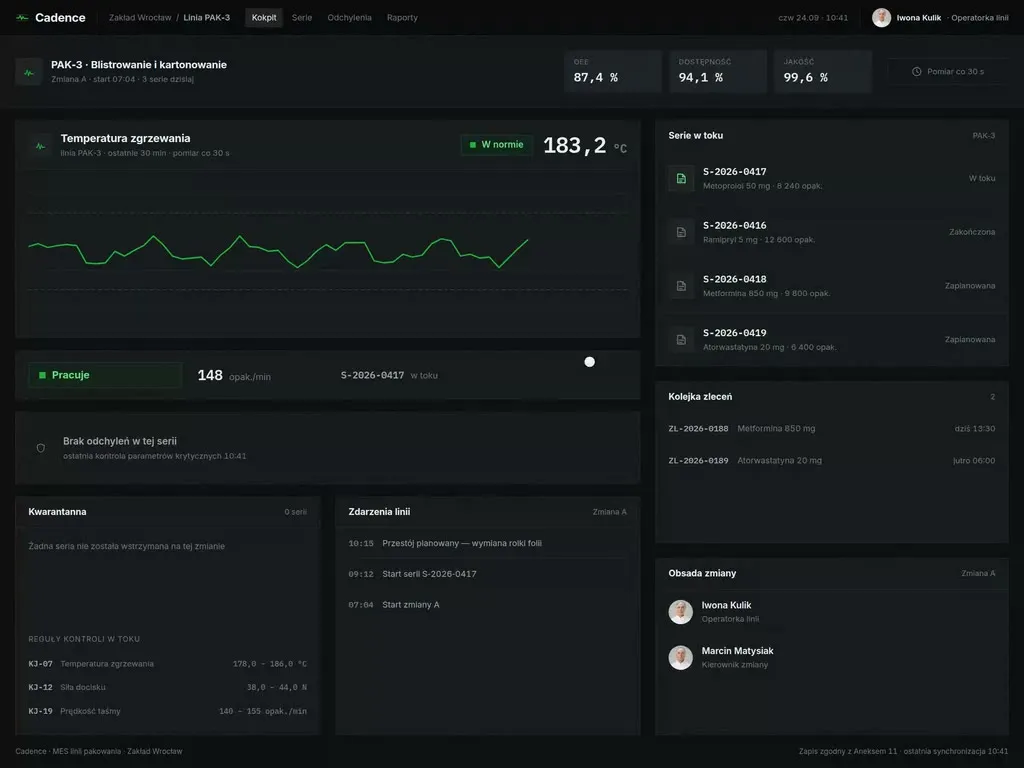
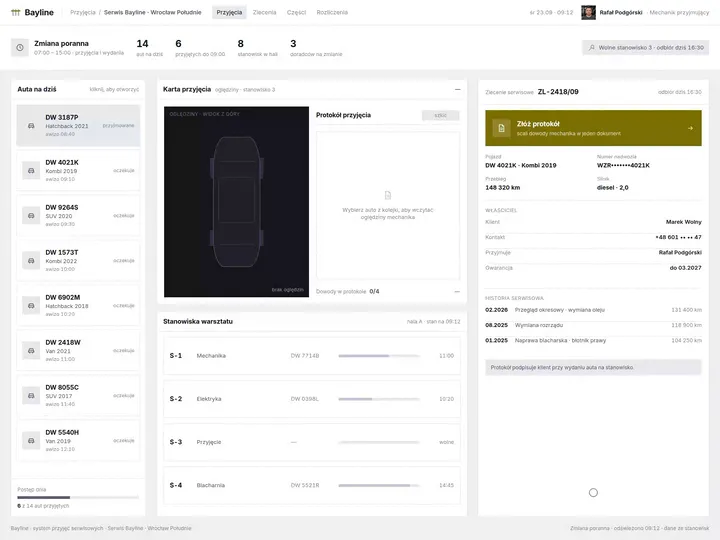
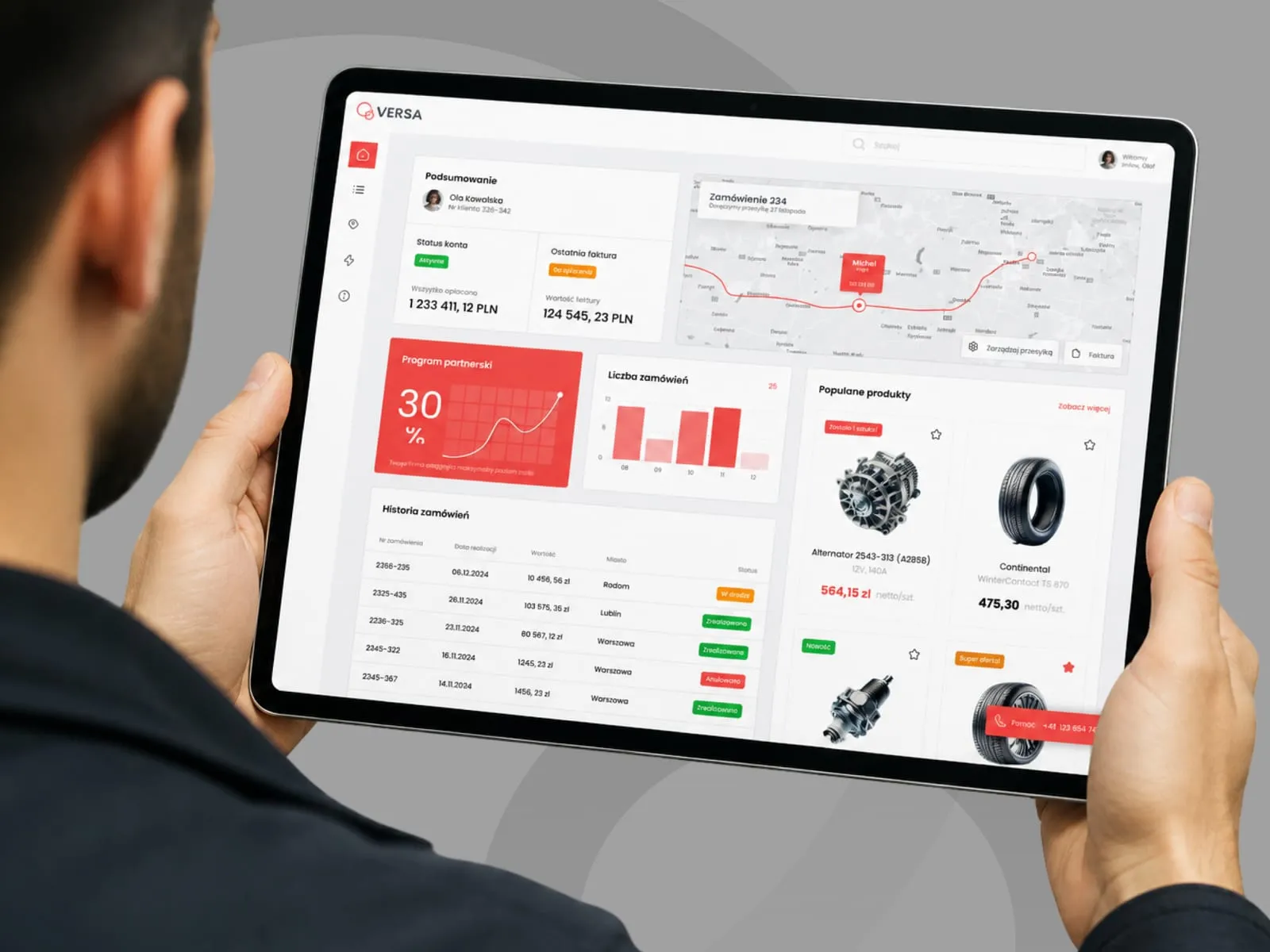
At Wzór UX agency you receive an interactive design of your automotive and mobility software, be it a DMS with service reception, a B2B platform for parts distributors or an EV charging app, and either our team or your own developers can then build it. That is how we designed Bayline, a dealership service intake system, and the VERSA B2B panel with its car parts catalogue.







Challenges
What challenges do we help solve in automotive and mobility?
Our approach
We design the inspection at the car, not at the desk: the advisor taps a spot on the vehicle drawing, takes a photo, and the defect gets its item number in the report straight away. The customer signs the report on the tablet before handing over the key, and at hand-back the same report opens with a single tap.
Scope of services
Our approach
We show conflicts between trim, engine and option pack at the moment an option is chosen, together with a suggestion of what to change so the car can be ordered. The showroom then receives an enquiry about a version the salesperson can price straight away.
Scope of services
Our approach
Before the driver arrives, the app shows on the map whether the point is free and responding. If the session still does not start, instead of an error code the screen says what to do now: check the plug, move to another point in the same charging area or contact support, who can already see the point number and the time of the attempt.
Scope of services
Who it is for
Which automotive and mobility companies do we design software for?
DMS and service reception
Dealers and authorised service centres run sales, service and the parts store in their DMS, and each morning the service advisor checks in cars in the reception area, tablet in hand and the customer standing alongside. In the intake system we design for service departments, the repair order opens with the data from the registration certificate and the service history, so the advisor only asks the customer about what the system does not know yet.
B2B platforms for parts distributors
Parts distributors and wholesalers sell to workshops where a mechanic orders a part between one repair and the next, often from a phone. We lay out the search on such a platform so that the search field accepts whatever number the mechanic has at hand: the VIN, the licence plate or the number on the old part, and every result shows whether the part can still arrive today.
Fleet and leasing portals
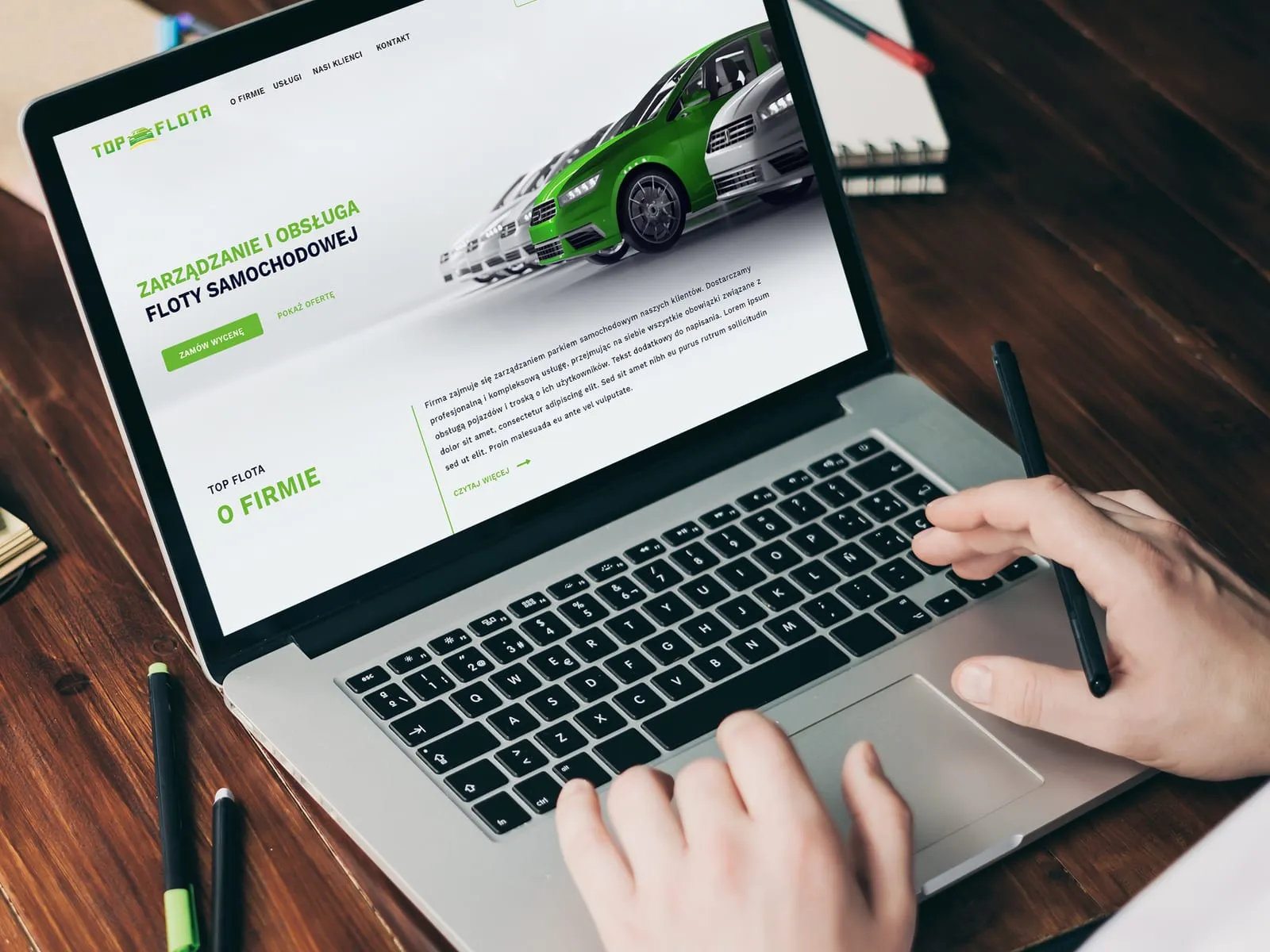
Fleet management companies and leasing firms serve two people at once: the fleet manager, who keeps track of costs and dates for every car, and the company car driver, who wants to sort out a tyre change or a damage claim without hunting for a phone number. For a car fleet management company we designed the Top Flota website, where fleet management, vehicle servicing, fleet audit and a service subscription sit as tabs of a single offer. When designing a portal for fleet drivers, we lay it out around matters rather than forms: drivers report them on their own, without a phone call, and the manager sees them on their list at once.
Car configurators
Importers and dealers give customers a configurator in which, in the evening and on a phone, people put together the trim, engine, paint, wheels and equipment before anyone comes to the showroom. In a configurator we keep the price after every change in the same place, and we prepare the summary so that the salesperson can open it in the showroom and pick up the conversation from the same version.
EV charging apps
Charging network operators and mobility service providers serve drivers who open the app at the charger, cable in one hand and phone in the other, often in the rain or after dark. In such an app we fit the beginning of a session onto a single screen with the point number, and the driver finds the charging progress and the stop button without searching the map again.

Why us?
Why choose our UX agency?
-
A shorter queue at morning check-in
The advisor opens the repair order at the car, and the vehicle data, photos and customer signature reach the DMS without being retyped from a sheet of paper. The next customer does not wait while someone at the desk types up the notes from the previous car.
-
Fewer parts sent back to the wholesaler
The mechanic orders a part matched to the actual car rather than roughly to the model, so fewer parcels come back from workshops. The warehouse and the courier work on orders, not on returns.
-
Fleet cars spend less time in the workshop
The driver reports damage with photos right after the incident, so the workshop has them before the visit and orders parts in advance. The fleet manager gets the car back sooner and does not have to call the workshop to ask for a date.
-
A senior team
A team of senior UX designers who have been designing interfaces for nine years, today for large organisations, SaaS companies and software houses. Seniors will take on your DMS, B2B platform or charging app, from research in the reception area and at the charger to sign-off.
-
Proven client trust
We have designed for 115 brands, and most of them come back to us with their next project.
-
Higher quality with AI
A designer with AI tools checks more variants of a check-in sheet or a charging start screen than they could draw by hand and picks the one that works. What reaches you is a tested version, not the first one that came out.
Process
How will we design your automotive and mobility software, step by step?
-
A conversation with your team

We set the goals and list the systems a car, a part or a charging session passes through
We sit down with the heads of service, sales, parts or the charging network and with someone from IT, because each of them knows a different stretch of the path from the customer to the importer's system. Together we choose one process to begin with and the measure by which you will know the change works.
Key steps
- Conversations with the heads of service, sales, parts, fleet or the charging network and with IT
- A list of systems: DMS, the importer's system, parts catalogue, ERP, charge point management system, telematics
- Choosing the process we start with
- Agreeing the measures: check-in time, disputes at hand-back, parts returns, failed charging sessions
Deliverables
- Project brief
- Map of systems and integrations
- List of measures
- Scope of the first stage
-
Discovery in the service reception, at the wholesaler and at the charger
We study the work where a car is checked in, a part is ordered and a session is started
We stand next to service advisors in the reception area in the morning, listen in on the phones at a parts wholesaler and go through starting a charge with drivers along the route. We note the workarounds, because they say more than an interview: a notebook at the reception desk, photos of defects on the advisor's own phone, a part number dictated over the phone, a screenshot of a configuration sent by email.
Key steps
- A morning in the reception area with the service advisors
- A day at the counter and on the phones of a parts wholesaler
- Starting a charge with drivers along the route
- Conversations with salespeople about configurator enquiries
- Interviews with fleet managers and company car drivers
Deliverables
- Research report
- Process map showing the workarounds
- Prioritised list of problems
-
Interactive system design
A design that advisors, mechanics, customers and drivers go through in their own conditions
We fill the prototype with your data: trims and packs from the importer's list, VINs of cars in the yard, part numbers from the catalogue. Advisors go through it on a tablet at the car, mechanics on a phone in the workshop and drivers at the charger, and we fix every moment of hesitation before anyone starts coding.
Key steps
- Screen architecture by role: service advisor, mechanic, salesperson, customer, driver, fleet manager
- Interactive design built on your data
- Exception states: customer refuses to sign, part out of stock, conflicting options, charging point not responding
- Prototype tests where the work happens
Deliverables
- Interactive design of every screen
- Component library
- Description of behaviour in exceptions
- Prototype test report
-
Build or design hand-off
We connect the new screens to your DMS, parts catalogue or charger system
The code is written by our developers, your team or the system vendor, and we give them a map of the connections: to the DMS and the importer's system, to TecDoc and the distributor's ERP, to the charge point management system over OCPP and the payment operator, or to telematics and the fleet's workshop network. Before the new system covers the whole network, we test it in one service centre, one wholesaler or one charging area.
Key steps
- Screen and field specification for developers
- Integration map: DMS, importer's system, TecDoc, ERP, OCPP, payments, telematics
- Support for the implementation team
- A trial in one service centre, wholesaler or charging area
Deliverables
- A working system or a package ready to build
- Integration specification
- Pre-launch trial report
-
Measuring after launch
We check against service, wholesale or charger data whether the change worked
Once the system is live, we set check-in time, disputes at hand-back, returns of wrongly matched parts and charging sessions that never started against the measurement taken before the change. We discuss the results with the heads of service, sales or the charging network, and rank the fixes starting with the one customers feel most.
Key steps
- Measuring check-in time and disputes at hand-back
- A review of parts returns and failed sessions
- Conversations with advisors, salespeople and drivers
- Plan of fixes
Deliverables
- Measurement report
- Prioritised list of fixes
- System development plan
Methods and technologies
Systems, standards and regulations we work with in automotive and mobility
-
DMS and the importer's system
When a dealer works in a DMS connected to the importer's system, repair orders, warranty claims and vehicle orders go through to the importer, and every brand has its own fields and code lists there. So we design the forms starting from the fields the importer requires, so that the advisor does not have to reopen an order after it is rejected.
-
TecDoc
When your platform takes its data from TecDoc, every part comes with a list of the vehicles it fits, and a mechanic can search by VIN. We then clearly separate a result matched to the actual car from parts that only fit the model, because that difference decides whether a part comes back.
-
OCPP
The driver's app only knows the state of a charging point from the charge point management system, which talks to the chargers over OCPP. We write the app's messages for the states that system actually receives, so a driver never sees "available" next to a point that is not responding.
-
AFIR
The AFIR regulation requires a mobility service provider to give the driver all price information for a charging session before it starts, with every price component shown separately, including e-roaming costs. That is why we put those components on the charging start screen, before the button, not in the terms and conditions.
-
Fleet telematics
When a fleet runs telematics, such as Webfleet, the manager sees the cars on a map in one panel, while drivers report damage and tyre changes by form or by phone. The fleet portal is laid out so that a driver's report sits beside the car the manager already sees on the map.
-
Trim and pack matrix
A trim and pack matrix is a spreadsheet in which, before the first configurator screen, we record which options rule each other out and which require others. The prototype rests on it, so option conflicts come up in testing with customers, not after launch.
Selected work
Our work in automotive and mobility
The projects in this section are the VERSA B2B panel for parts sales, and a website, a sales brochure and a product catalogue for companies connected to the automotive industry.
-
Logistics & Fulfilment
VERSA
View projectThe VERSA B2B panel with an automotive parts catalogue: account overview, invoice and payment status, shipment tracking on a map, a partner discount programme, and order history.
-
Automotive & Mobility
Top Flota
View projectThe Top Flota site - a car fleet management company. A dark-navy-and-green layout with “About us” and “Our offer” sections, service tabs and wireframe-style car graphics. Mockups shown on a laptop in café and office settings.
-
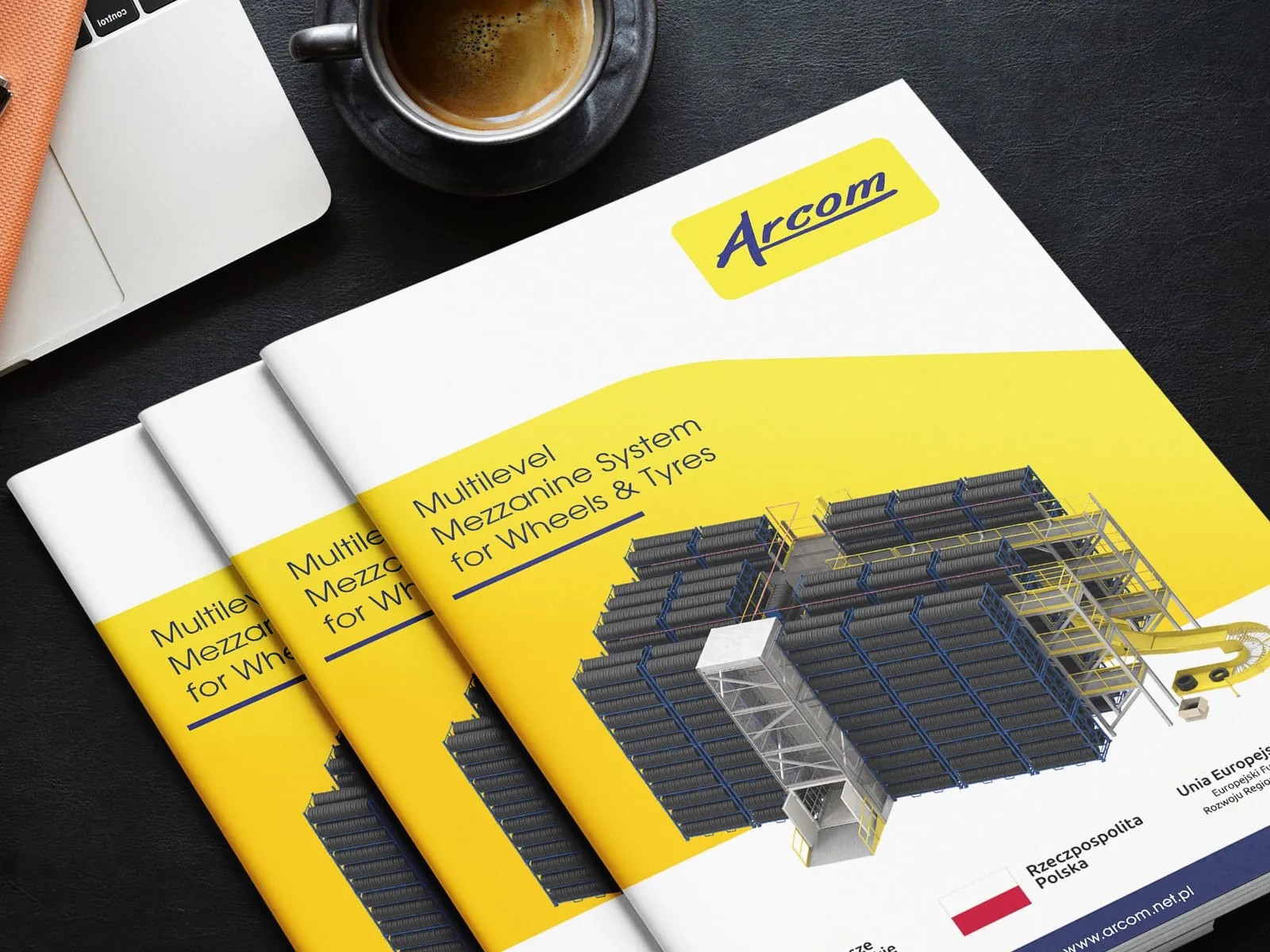
Arcom
Catalogue for a warehouse mezzanine system
-
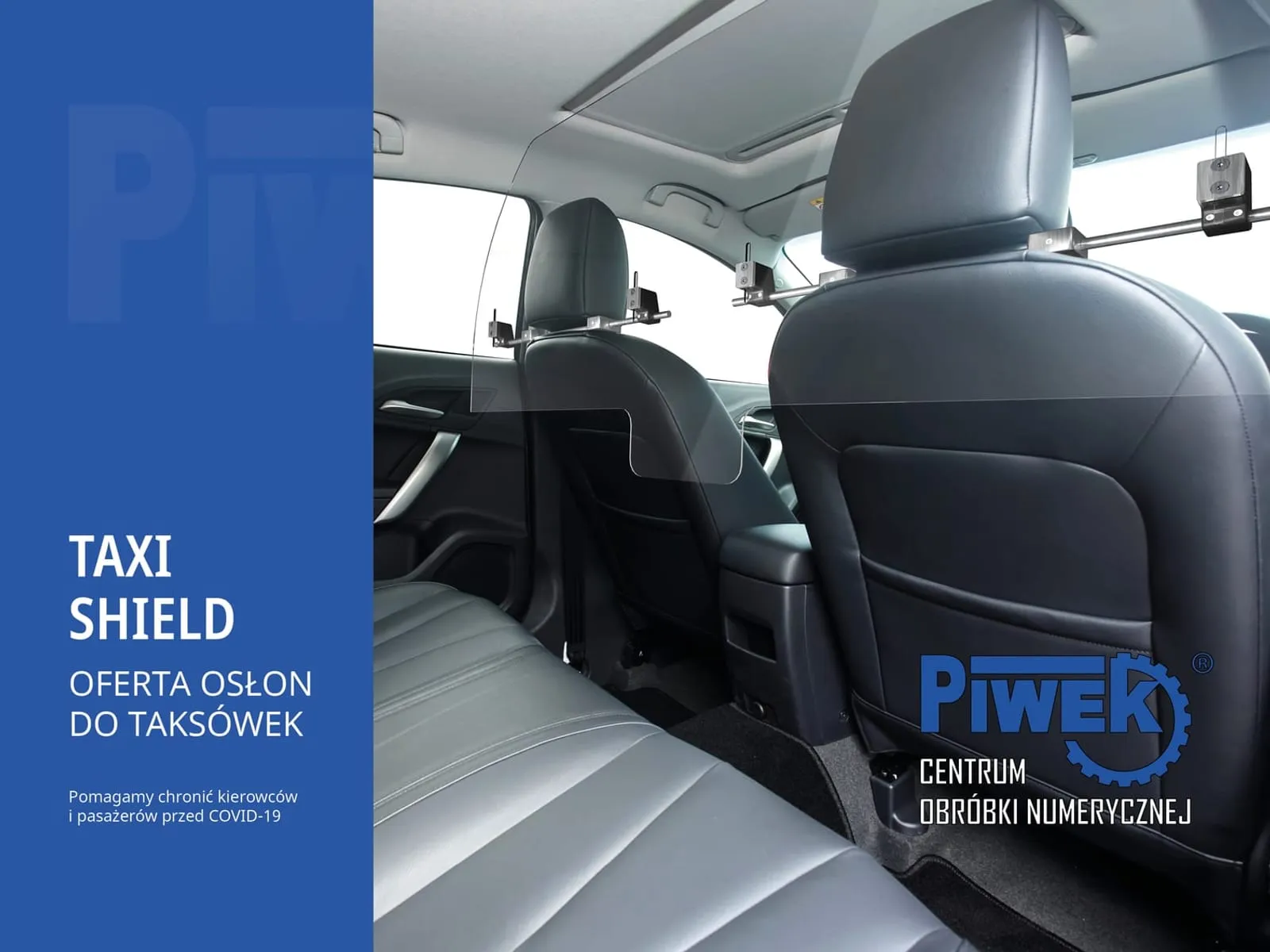
Piwek
Promotional folder for the "Taxi Shield" screens
- See what else we build Projects
Start your automotive and mobility software project
One team designs your DMS, B2B platform, configurator, fleet portal or charging app and builds it, starting with research in the service reception area.

Client voices
What our clients say
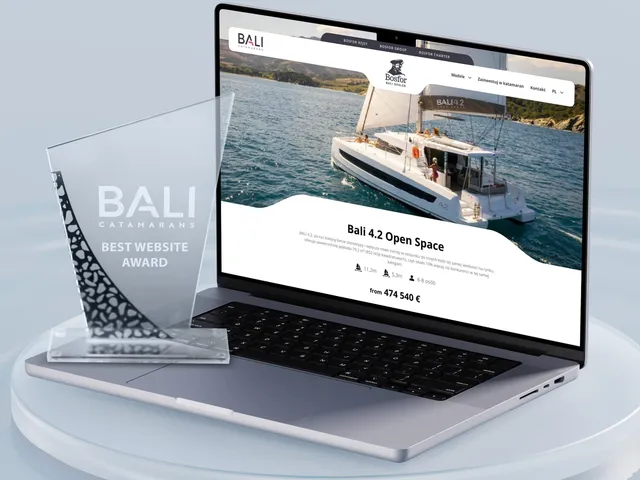
 Maja Wieloch-Silecka Operations Director, Bosfor Group

“Working with the Wzór team was a genuinely great experience! They always answered our questions quickly and were flexible about our comments. They have no shortage of creative ideas and are at the same time thoroughly reliable and on time. The end result fully met our expectations; we recommend them to anyone looking for professionals who care.”
 Piotr Alberski Chief Operating Officer, Agencja XO Media

“Our clients expect us to act fast and effectively across a very wide scope - from building a brand, through a website with a store, to running an effective sales campaign. Not an easy task, but doable when you have a tight-knit team and partners who take on challenges on the fly. For us, quality, accountability and commitment are key, and working with UX Agency Wzór gives us that 100%.”
 Mateusz Swół Chief Operating Officer, Sellace

“Our cooperation with UX Agency Wzór started with our own website. We really liked the way they work, so we decided to subcontract projects for our clients to them on a White Label basis. We loved their workflow, the way they hand projects over to our team, their documentation and their work on the design system. Now we can take on bigger risks.”




























The team
Who will design your automotive and mobility software?
-

Aleksandra Bondar
Senior UX/UI Designer
View profileHow can I help you?
“I will design the check-in sheet for the advisor's tablet so that a photo of a defect lands on the right spot of the car drawing with one tap and the report can be signed without putting the keys down.”
-

Katarzyna Adamczuk
Prezes, Analityk Biznesowy
View profileHow can I help you?
“I will map out how a repair order travels from the tablet into the DMS and on to the importer's system, and agree with your team who owns each field along the way.”
-
Patryk Korycki
CEO, Analityk Biznesowy
View profileHow can I help you?
“I will agree the project scope and budget with you, and during the build I will propose which service centre, wholesaler or charging area moves to the new system first.”
-

Tadek Wadas
Senior UX/UI Designer
View profileHow can I help you?
“I will test the prototype with advisors in the reception area and with drivers at the charger, then write down which screen cost each of them the most time.”
FAQ
Frequently asked questions about automotive and mobility software
What is a DMS for a car dealership?
A DMS (Dealer Management System) for a car dealership is software that brings together vehicle sales, service, the parts store, finance and data exchange with the manufacturer or importer in one place. The salesperson prepares offers in it, the service advisor opens repair orders and the parts store orders parts. When we design DMS screens, we begin with the workstation furthest from the desk: check-in at the reception area.
How does a vehicle check-in on a tablet work?
A vehicle check-in on a tablet is carried out by the service advisor at the car: they read the vehicle data from the registration certificate, record the mileage, photograph the damage and mark where it is on a drawing of the vehicle. The customer signs the repair order on the screen, and the data reaches the service system without being retyped from paper. We set the order of these steps so that the advisor walks round the car only once.
What is TecDoc?
TecDoc is a catalogue of data on spare parts and vehicles run by TecAlliance, which calls it the leading data standard in the European automotive market. Parts manufacturers, distributors, wholesalers, online stores and workshops use it because it links every part to the vehicles it fits. On B2B platforms, TecDoc data feeds the search and the filter for parts that fit the selected car.
How do I find a car part by VIN?
You find a car part by VIN in a catalogue that identifies the car from that number and shows the parts that fit that version of the vehicle, for example in catalogues based on TecDoc. In TecDoc you can also search by registration number, vehicle data or the manufacturer's part number. Next to the result we display which number the vehicle was identified from, so the mechanic can see at once whether the version matches.
How does a car configurator work?
A car configurator takes the customer step by step through choosing the model, trim, engine, paint, wheels, upholstery and equipment, and recalculates the price after every change. At the end the customer gets a summary and can ask the showroom to get in touch, and with some brands also start a finance application. When designing a configurator, we first write down the questions customers ask salespeople in the showroom, because the configurator has to answer them on its own.
What is OCPP?
OCPP (Open Charge Point Protocol) is an open communication protocol between charging stations and charging management systems, developed by the Open Charge Alliance. It makes a charging network less dependent on one vendor's proprietary systems; version 1.6 from 2015 is still widely used, and version 2.0.1 from 2020 was approved as the IEC 63584 standard in 2024. This is the protocol a charger uses to report its state, and the app on the phone then relies on that report.
How do you pay for charging an electric car at a publicly accessible recharging point?
At a publicly accessible recharging point put into service from 13 April 2024, you can pay for charging an electric car on an ad hoc basis in at least one of three ways: with a card in a payment card reader, contactlessly on a device that can read at least payment cards or, at points with a power output below 50 kW, through an internet-connected device such as one that generates a QR code. The AFIR regulation requires this of the operator: ad hoc charging there has to be possible with a payment instrument widely used in the Union. From 1 January 2027, a card reader or contactless payment will also have to work at older points with a power output of at least 50 kW along the TEN-T road network and in safe and secure parking areas. So on the operator's map we mark for every point how you pay there, before anyone gets to it.
What is fleet management software?
Fleet management software is software connected to devices in the vehicles, in which a company tracks the location, technical condition and servicing of every vehicle and how its drivers drive. Fleet managers, drivers and administrative staff use it, and the office can send jobs through it to terminals in the vehicles. In it we keep the manager's view of the whole fleet separate from the view of the person behind the wheel, who has one car and one matter in front of them.
How does a company car driver report damage?
A company car driver reports damage to the leasing company or the fleet management company: through a form on its website, by phone or in a mobile app. In designing fleet apps, we turn the photos into steps with a hint, so that they show what the workshop needs to assess the damage. In a mobile app the driver enters the place of the incident and the type of collision, marks the damage on a diagram of the car, takes photos and picks a workshop and a date for the inspection.
Related services
Services related to automotive and mobility software
You know that checking a car in for service takes too long, but not at which step.
Let us start by observing the reception area and reviewing the screens where the advisor loses time.
You are choosing a DMS, a B2B platform or a charging app and are looking for a starting point.
We will draw up a list of requirements with service, the parts team and IT for you to take to vendors.
You have a configurator design and want to check whether customers get as far as an enquiry.
We will go through it with you at a consultation or measure where customers abandon the configuration, before it reaches the dealer network.