



Table of contents
An AI-generated tomato in a supermarket flyer. A realistic visualisation of a flat where AI “added” the furniture. These are not exotic textbook cases. The Polish legal news site Prawo.pl gives both, in its article on why AI-generated content must be labelled from 2 August (in Polish), as typical images that need a label. On a company website the same problem usually looks like this: a team “at work” that does not exist, a production hall that was never built, a product in a scene nobody photographed.
Since 2 August 2026, Article 50 of the AI Act has applied directly across the EU. The European Commission confirms this in its FAQ on Article 50 of the AI Act, and so does the Polish Ministry of Digital Affairs in its note on what changed on 2 August 2026 (in Polish). We cover the full picture of that article, with chatbots and marking inside products, in our piece on what Article 50 of the AI Act changes in a product interface. For images on a company website, what matters most are Article 50(4) and (5): when an image is a deepfake and what the label must look like.
Two obligations, two addressees
Article 50 splits the work between two roles, and that distinction saves a lot of worry.
| Who | What they must do | Provision |
|---|---|---|
| Provider of the tool that generates images | Mark the output in a machine-readable way: metadata, watermark | Article 50(2) |
| Deployer, i.e. the company or agency that generates and publishes the image | Visibly disclose that the image was generated or manipulated by AI, if it is a deepfake | Article 50(4) |
The first obligation does not settle the second. In the FAQ, the Commission says plainly that the provider’s machine-readable mark is not enough, because the disclosure to the viewer must be perceivable without any tools. The generator can write whatever it likes into the file. The website still needs a label.
And who exactly is the “deployer”? Whoever used AI to produce the content. Polish lawyer Tomasz Zalewski says in the same Prawo.pl article that if an advertising agency generates content for a well-known brand’s advertising, the labelling obligation will rest with the agency, not the brand. The brand can still be liable under other rules, such as unfair competition law. In practice the label should therefore travel with the file, from whoever generated the image to whoever publishes it.
When do you have to label an AI-generated image
Not every time. Article 50(4) covers deepfakes, and a deepfake under Article 3(60) is AI-generated or manipulated image, audio or video content that resembles existing persons, objects, places, entities or events and would falsely appear authentic. In the FAQ, the Commission breaks this into three criteria that must all be met: resemblance, existence (something that exists, could exist or could have existed) and a false impression of authenticity, judged by the context and the expectations of the audience the content is aimed at.
- Label it: an AI product image that could mislead about the product’s appearance, features or quality, and realistic AI “customers” and people. That is how the law firm Gleiss Lutz reads the Commission’s guidelines in its analysis for the advertising industry. Add the tomato and the AI-furnished flat from the Prawo.pl article.
- No label needed: things that do not exist (a dragon), clearly fantastical or physically impossible content, aliens, robots, talking animals. Gleiss Lutz sees it the same way, and so does artificialintelligenceact.eu in its practical guide to Article 50.
- A real product on an AI background is not a deepfake, as long as the ad does not mislead about how the product looks, Gleiss Lutz points out. Lawyers at Baker McKenzie add, in their overview of the new disclosure rules for AI-generated marketing content, that backgrounds and effects the viewer does not take as authentic are probably not deepfakes either.
- Standard editing needs no label. Gleiss Lutz lists minor cropping, minor colour correction, removing a speck, blurring a face and removing a background visible in the original. Adding, removing or swapping an object in a way that changes the meaning of the image does.
There is also an exception for evidently artistic, satirical and fictional works, where a lighter disclosure is enough. It does not cover advertising. Gleiss Lutz points out that content that mainly serves commercial purposes does not benefit from this exception. A company website is commercial material in that sense. Even when the image is very artistic.
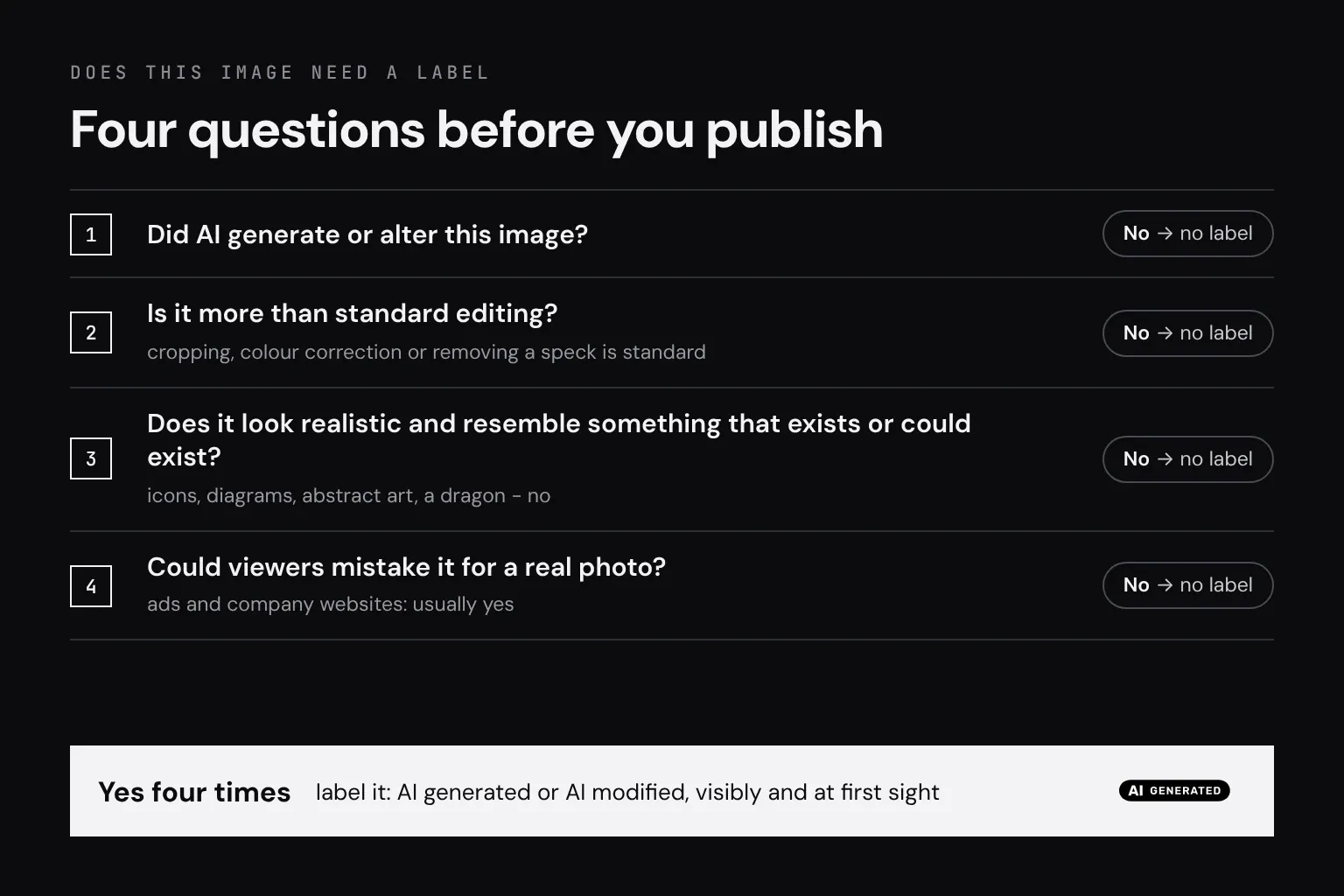 One “no” ends it without a label. Four “yes” answers and the label has to be visible straight away
Text has a separate and narrower obligation. On its page with the EU icons for labelling AI-generated content, the Commission explains that it covers text published to inform the public on matters of public interest that has not undergone human review or editorial control. A service description on a company website does not fall under it.
Typical images on a company website
| Image | Label it? | Why |
|---|---|---|
| Icons, diagrams, charts, abstract backgrounds and textures | No | Nobody will take them for a photo |
| Clearly fantastical or stylised illustration | No | It does not pretend to be something that exists |
| Photo of a real product on an AI-generated background | Usually no | A real product on an AI background is not a deepfake as long as the background does not mislead about the product or the place |
| Photorealistic AI office, hall, interior or completed project | Yes | It resembles a place that could exist and looks like a photo |
| Realistic AI people: “the team”, “customers”, “a consultant” | Yes | A textbook deepfake, plus the risk of misleading |
| A product whose appearance AI invented | Yes, and preferably not as a “product photo” at all | The label does not remove the risk of misleading advertising |
| Real photo with improved sharpness or colour, a speck removed | No | Standard editing |
| Real photo with an object added or removed that changes the meaning | Yes, as “AI modified” | It changes what the image says |
The riskiest is the fifth row: generated “team” photos on the About page. They look like people who work for you. Without a label it is a deepfake in its textbook form. With a label, still an odd branding decision, but at least an honest one.
When it applies and what about images from before August
Article 50(4) has applied since 2 August 2026, and the Digital Omnibus, Regulation (EU) 2026/1744, did not postpone it. It only gave providers of tools already on the market until 2 December 2026 for the machine-readable marking under Article 50(2), in the new Article 111(4) of the AI Act. That relief is for generators, not for your website.
Images published before 2 August 2026 do not have to be labelled retroactively. The Commission encourages it in the FAQ, and honestly, at the next site refresh it is worth just doing. An AI image does not stop looking like a photo because it has been up since spring.
What a correct label looks like
Article 50(5) itself is general: disclosure must happen “in a clear and distinguishable manner at the latest at the time of the first interaction or exposure”, in line with accessibility requirements. Gleiss Lutz adds that fine print in the footer or information that lives only in the page code does not meet it.
The details come from the Code of Practice on Transparency of AI-generated Content. It is voluntary, its final version was published on 10 June 2026, and the Commission and the AI Board have confirmed it as an adequate way to demonstrate compliance. How the label looks and where it goes is covered by measures 1.1 and 1.2 in section 2 of the Code:
- Appearance (1.1). The main element is the capital letters “AI”, in English unless national law requires the national language. Letters of equal height, proportions kept when scaling. Size, colour and contrast are free as long as the mark is legible. A tag reading “generated” or “modified” is recommended, in the icon, next to it or in a second layer, for example on hover, with that layer saying what AI changed.
- Placement (1.2). Somewhere with no other overlays, for example the top right corner of the image (1.2.2 a). Visible straight away, without any action by the user (1.2.1 a). Embedded in the image or as an interface overlay that looks like part of the image (1.2.1 c). With spacing from other elements and legible on any background (1.2.1 d).
Note “without any action”. A label that only appears on mouse hover barely exists on a phone.
EU icons
The Commission publishes the icons on its page with the EU icons for labelling AI-generated content: three variants, each in four versions (black, white and both at 50% transparency), in SVG and PNG. The licence lets anyone use them for free, without attribution to the Commission.
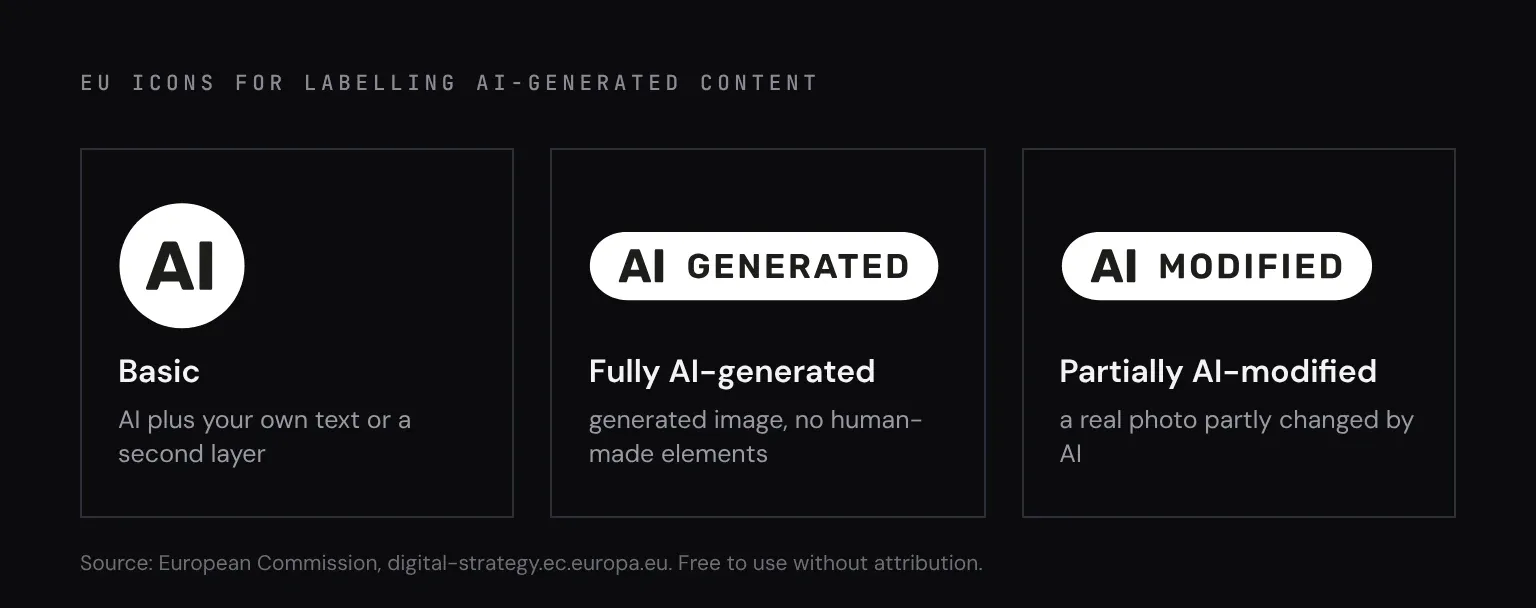 The three official European Commission icons, shown here in the white version for dark backgrounds
| Icon | When to use it |
|---|---|
| AI (basic) | AI was involved in creating the image, and your own text or a second layer with details sits next to it |
| AI GENERATED | The image is entirely AI-generated, with no human-made elements apart from the prompt |
| AI MODIFIED | A real photo partly modified by AI, for example an empty flat furnished by AI |
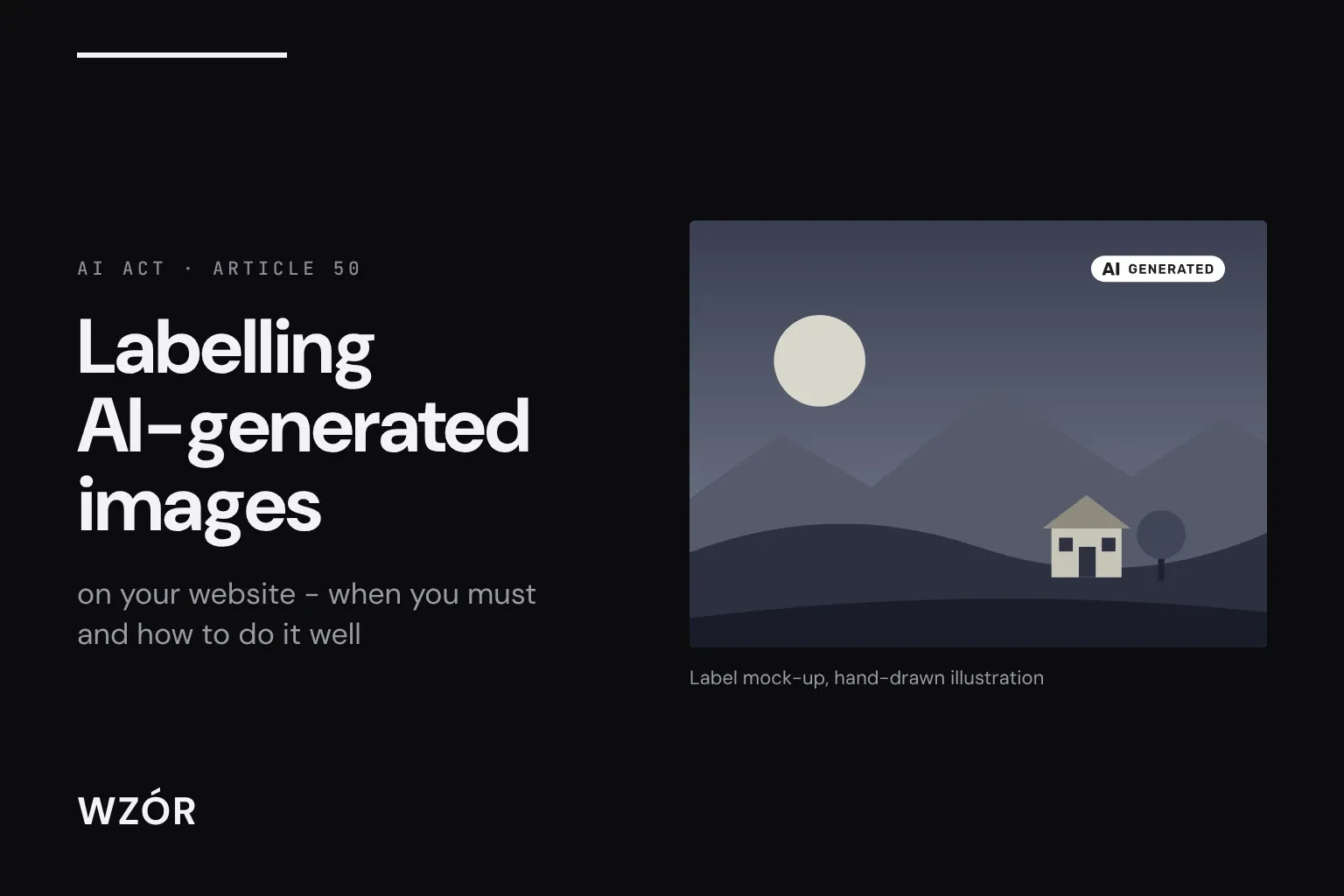
According to the icons page, the icon should sit on the image or in an interface overlay, be visible at first exposure, in a spot free of overlapping elements, stay visible when the content is downloaded or reshared, and screen readers should get alt text or an ARIA label saying the image was generated or manipulated by AI. Two caveats: the icons are optional (your own label is fine if it meets these conditions) and the icon alone does not establish compliance.
The Commission also reports that the icons were user-tested, and performance improved across all measures when the icon was accompanied by a text label. Icon plus a word. Not the icon on its own.
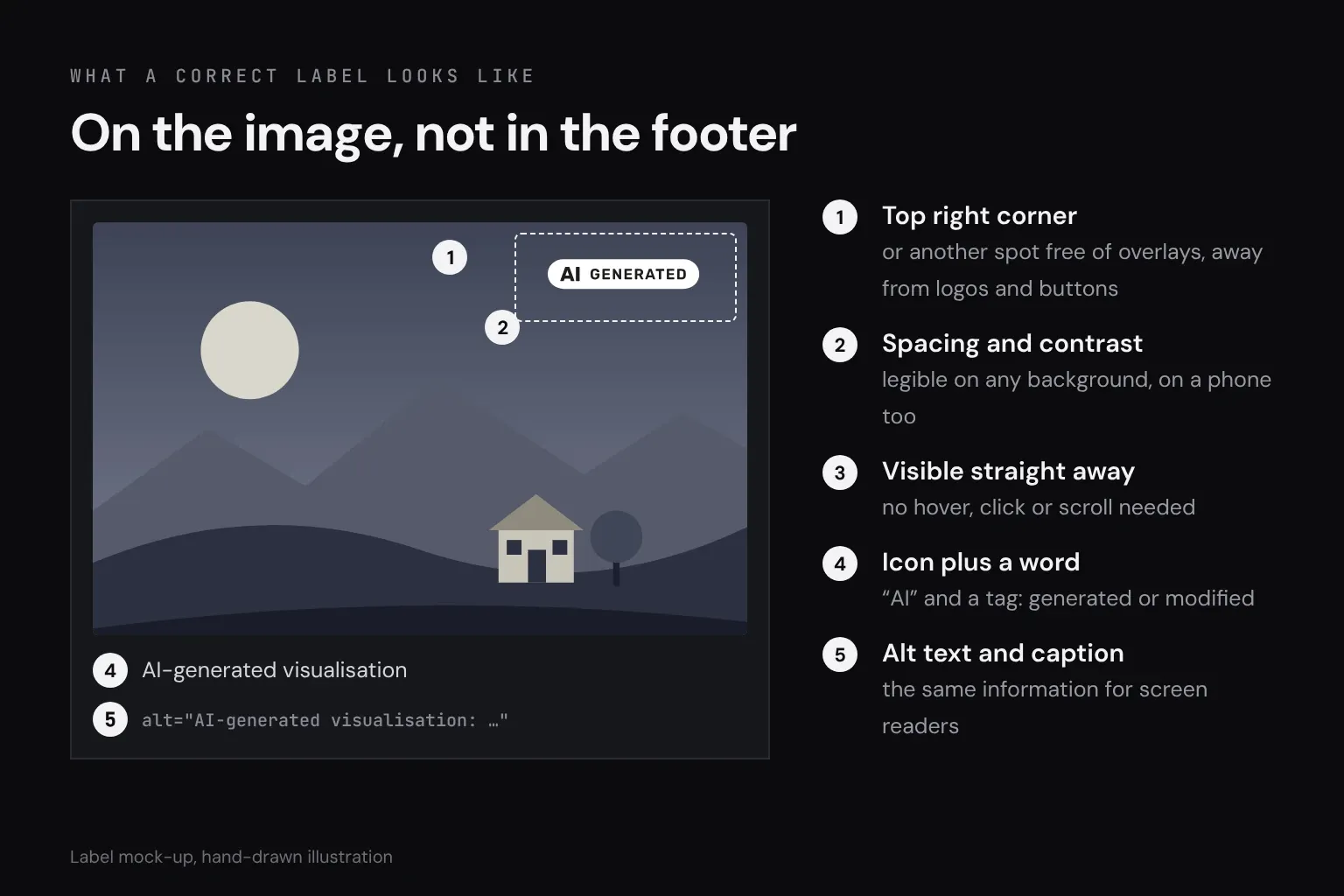 Mock-up on a hand-drawn illustration: the icon in a corner with no other overlays, a word in the caption and the information in the alt text
How companies that already label AI images do it
On ten company and media websites, a label currently sits next to the image. These are examples of practice, not compliance templates: we are not judging whether each of these images had to be labelled at all, only how the label measures up against the Code and the EU icons page. None of them uses the official EU icon. Everyone writes their own text. They do, however, fall into four patterns.
A caption under the image.
- Iberdrola (energy, Spain) writes “Imagen generada con IA” under a realistic kitchen with a heat pump. Visible straight away, but small grey type outside the image, so it does not survive a download, and the alt text says nothing about AI.
- nefino (software for the energy sector, Germany), under an office scene with two men and a roll-up banner bearing the company logo: “Symbolbild, KI-generiert” in light grey italics. Low contrast and small type on an image with realistic people and a real logo, which is exactly the kind of content most likely to pass as authentic.
- Gazeta Prawna (Polish news site): “Grafika wygenerowana za pomocą AI” with a source line naming the tool. A classic editorial caption, legible and specific.
A bar or badge on the image, in HTML.
- FERCHAU (engineering services, Germany): a light bar in the bottom right corner, “Symbolbild, KI-generiert” run together with the image copyright line. On the image and visible straight away, but small and easy to mistake for an ordinary copyright notice.
- ConPad-Immobilien (real estate, Germany): a black bar along the bottom of a photorealistic villa, “Symbolbild - KI-generiert”. Good contrast, very small text on a large hero. And an industry commentators cite as a textbook case for labelling.
- Italian Food Academy (culinary school, Italy): an “Immagine generata con l’IA” badge on a dark semi-transparent background, consistently on every image with people. Legible. But the images are CSS backgrounds, so there is no alt text at all.
Text inside the image file.
- Lufthansa (airline): “AI-modified” in the bottom left corner of the seat photos. A good use of “modified”, and the text survives a download. The weak part: thin, small and light, it almost disappears on a bright photo. The Up Front, in its article on the photos of Lufthansa’s new seat, reported that in the seat reservation flow the same photo is cropped so the text is not visible. A label in the corner of the file loses to a responsive crop.
- edgecon (industrial computers, Germany): three layers at once. A “KI-generiert” badge in the file, a caption naming the model and alt text ending with a note that the image is AI-generated. The most complete example of the ten.
- Pixelz (product photo editing for e-commerce): a sparkle icon and “AI GENERATED” in the bottom right corner of the hero, baked into the footage. It stays in the file, and some images further down have “AI-generated” in their alt text. But semi-transparent white on bright sand is hard to read.
An icon in the corner, text on hover.
- Traulux (audiovisual systems): a custom icon in the top right corner that expands to “Immagine generata con l’IA” on hover or focus. Position and accessibility are good:
role="img",aria-label, keyboard support. Except that at first sight you only see the sparkles, without the word “AI”, and a phone has no hover.
Most get it half right: the position is there but the contrast is not, or the contrast is there but the alt text is not. Only three sites (edgecon, Traulux, Pixelz) tell screen reader users about AI as well, and Gazeta Prawna does so partly. And text in the file and an HTML overlay win on different fronts: the first survives a download but gets lost to cropping and poor contrast, the second is legible but does not leave the website with the image.
How to do it on your website
When we design company websites, we start from a simple assumption: the label is part of the image component, not something an editor has to remember with every post.
Label in HTML, label in the downloadable file. The Code allows an interface overlay that looks like part of the image, and the icons page requires the label to stay visible when the content is downloaded or reshared. On the website, then, the safest option is an HTML overlay pinned to the visible frame (it survives any crop by object-fit: cover), while a file someone might download or share carries the icon embedded in the image with a safe margin. The Lufthansa lesson in one sentence.
Solid icon, not transparent. The 50% transparent versions look nice in a mock-up and lose on a photo with a bright sky or sand, as the Pixelz example shows. The solid pill has its own background, so contrast is guaranteed on any image. White on dark scenes, black on light ones.
Icon plus a word. The icon in the corner and a caption under the image: “AI-generated visualisation”, “Photo modified by AI”. If you want to say more (what exactly AI changed), that is what the second layer is for, but the first layer has to work without it.
Alt text says the same. The alt describes the image, and the icon gets its own alt along the lines of “AI-generated”. No alt at all, as with images set as CSS backgrounds, leaves a screen reader user with no information. If you do not know how many such images your website has, a WCAG accessibility audit will surface them along the way.
The component with the label in HTML and CSS:
<figure class="ai-image"> <div class="ai-image__frame"> <img src="/img/office.webp" alt="Open-plan office by the windows" width="1600" height="1000"> <img class="ai-image__label" src="/img/eu-ai-generated-white.svg" alt="AI-generated" width="133" height="30"> </div> <figcaption>AI-generated visualisation</figcaption></figure>.ai-image__frame { position: relative;}.ai-image__frame > img:first-child { display: block; width: 100%; height: auto;}.ai-image__label { position: absolute; top: clamp(8px, 3%, 24px); right: clamp(8px, 3%, 24px); width: clamp(96px, 18%, 180px); height: auto; pointer-events: none;}The label takes its position and size from the image frame, so on a phone it never shrinks below 96 pixels wide and on a wide screen it never grows past 180. White icon on dark scenes, black on light ones, and nothing else in the top right corner: the gallery button, the logo or the slider arrow go somewhere else.
In a CMS it is one field, not discipline. In the media library each image gets an “AI label” field with three values: generated, modified, no label. The template then adds the icon, caption and alt text on its own. The editor picks one value when uploading the file instead of remembering the regulation with every post.
Keep the metadata. Generators write provenance information into files (C2PA, for example). Compression and conversion to WebP can easily strip it “to tidy up”. Don’t. It complements the visible label rather than replacing it, but it costs nothing.
And test on a phone. Every weak label in the list above looks worse at 390 pixels wide than on a desktop monitor.
A label does not fix misleading advertising
An “AI” label does not exempt you from the ban on misleading advertising: Directive 2005/29/EC towards consumers, Directive 2006/114/EC in B2B and the Polish Act on Combating Unfair Competition. Both Gleiss Lutz and Prawo.pl point this out: an image correctly labelled as AI can still be unfair if it misleads about the product’s features.
A generated “photo” of a device that does not exist yet, with a small “AI generated” in the corner, is still a promise the product may not keep. A label will not help there. A different image will.
Outside the EU - USA, Turkey, the Middle East
One website usually serves several markets, and outside the EU the obligations are weaker or still being drafted.
- USA. There is no general federal obligation to label AI images on company websites; the general ban on deceptive practices applies (FTC Act, Section 5). The exception is New York: since June 2026, an ad featuring a “synthetic performer”, meaning a realistic AI human, has to disclose it clearly, under a civil penalty that rises for subsequent violations. That is what New York Senate Bill S8420A provides, and Governor Kathy Hochul announced when it took effect. The California AI Transparency Act (SB 942), as amended by bill SB 1000, places obligations on tool providers from 2 August 2026, not on companies that publish images.
- Turkey. According to the overview of AI transparency laws on regulations.ai, draft AI bills provide for labelling AI content, but for now they are only drafts.
- Middle East. Saudi Arabia’s SDAIA, in its non-binding guidelines on deepfakes, recommends visible, persistent watermarks or information in the description or captions. According to regulations.ai, the UAE, Qatar and Israel only have guidelines and ethical principles, with no binding labelling obligation.
The practical takeaway: with one website for several markets, the simplest option is to apply the EU standard everywhere. It is the most demanding one, and a label built to it also covers what the others ask for.
Fines and supervision in Poland
Breaching Article 50 can cost up to EUR 15 million or 3% of annual turnover, under Article 99(4) of the AI Act. In Poland the supervisory authority is the Commission for the Development and Security of Artificial Intelligence, set up by the Act of 3 July 2026 on artificial intelligence systems (in Polish; Journal of Laws 2026, item 1003), signed on 24 July 2026. The chapters on the authority and penalties have applied since 28 October 2026.
So the obligation has applied since August, and the body that can enforce it since the end of October. If your website carries realistic AI images without a label, this is not a topic for next quarter.
This is information, not legal advice. Legal status as of 20 November 2026. In borderline cases, it is worth confirming how a specific image should be classified with a lawyer.
Sources
Legislation
- European Parliament and Council of the EU Regulation (EU) 2024/1689 laying down harmonised rules on artificial intelligence (AI Act)
- European Parliament and Council of the EU Regulation (EU) 2026/1744 (Digital Omnibus on AI)
- Journal of Laws of the Republic of Poland Act of 3 July 2026 on artificial intelligence systems
- New York State Senate NY State Senate Bill 2025-S8420A
- California Legislature SB-1000 California AI Transparency Act
Authorities and institutions
- European Commission Transparency obligations under Article 50 of the AI Act
- European Commission Code of Practice on Transparency of AI-generated Content
- European Commission EU Icons for labelling AI-generated content
- Polish Ministry of Digital Affairs AI Act - co się zmieniło 2 sierpnia 2026 roku?
- Governor of New York State Governor Hochul Announces First-in-the-nation Law Requiring Disclosure When Advertisements Include AI-generated Synthetic Performers is in Effect
- SDAIA (Saudi Data and AI Authority) Deepfakes Guidelines: Mitigating Risks While Fostering Innovation
Commentary
- Prawo.pl Od 2 sierpnia treści tworzone w AI muszą być znakowane
- Gleiss Lutz Update on AI transparency in advertising: the European Commission's guidelines on the AI Act
- Baker McKenzie AI-generated marketing content: New EU AI Act disclosure rules and the UK position
- artificialintelligenceact.eu The EU AI Act's Transparency Rules: A Practical Guide to Article 50
- The Up Front Welcome to the age of seatfishing: Lufthansa tests recliner midhaul business, but the picture is “AI-modified”
- Regulations.ai Which countries require AI transparency?

Co-founder and President of the UX agency Wzór. Business analyst - she leads interface projects for mobile, desktop and e-commerce applications, from business analysis, research and information architecture to polished UI.