



Table of contents
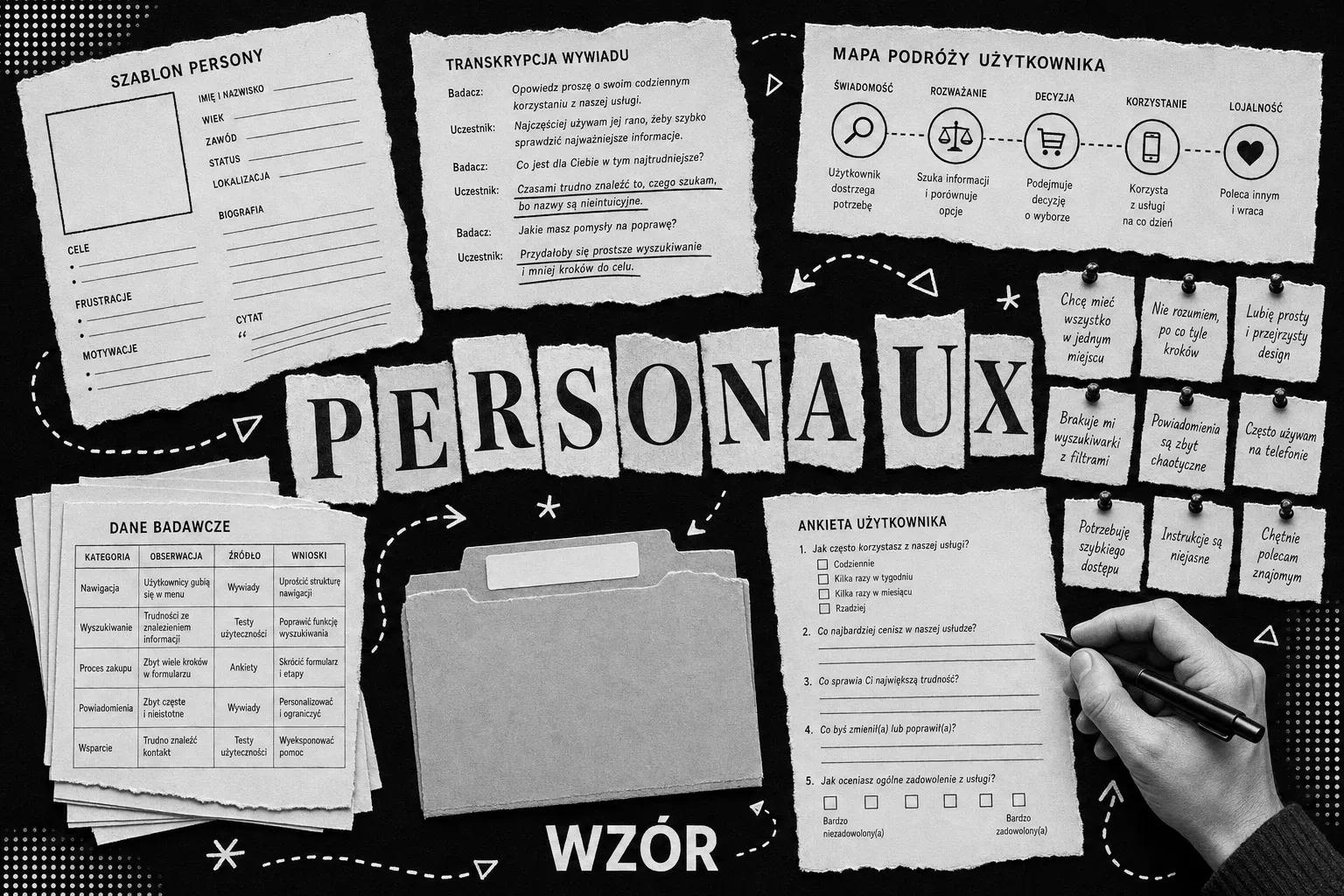
A solidly built UX persona is the recipe for a great site, service, online store and app. It’s a signpost for everyone involved in creating a digital product. Thanks to it they won’t stray off a good course, and you’ll gain time and, quite possibly, save budget too. Download the template and create your own personas. I’ll tell you how to do it step by step.
What is a UX persona?
A UX persona is a description of a character that represents a specific group of target audiences for your app, site, online store or service. It can be defined as an archetype (a model) of users who are similar to one another in some respect. Its traits, goals and needs express the requirements of a larger group of real people - your potential customers.
It’s easier to understand with a concrete example. Let’s say you’re working on a news service about IT, marketing and business. Your personas could be e.g.:
- an impatient, lively and curious UX tester, hungry for the latest news from their industry;
- a composed, sensible entrepreneur looking for possible improvements and savings they could implement in their company;
- an ambitious marketing specialist who wants to stay up to date, values efficiency and cares about the best possible results and a promotion.
To call these 3 descriptions UX personas, they need to be analysed in more detail, characterised and grounded in concrete data - I’ll talk about that more in a moment. As you can see, a UX persona is a filter through which you can look at your digital product from the user’s perspective.
What business benefits does a UX persona provide?
Let’s go back to the example with the service. Imagine you’re facing a choice about the size of a button (CTA). You have personas worked out and you know that your users most often use the service on their way to work, viewing it on their smartphones. As a result, you’ll decide on larger buttons to make it easier for them to move around the site and achieve their goals.
The better you get to know your target group, the faster you’ll meet their requirements and avoid solutions that have nothing to do with their needs. This way:
- the product team will learn exactly who it’s creating for;
- it will understand the user’s perspective and find it easier to set aside its own personal preferences while designing;
- it will better understand what a real audience might actually need;
- it will be easier for you to make design decisions and set priorities;
- you’ll be able to create strong UX copywriting;
- you’ll save the time and budget that would be needed to design and implement completely misguided solutions.
Elements of a UX persona
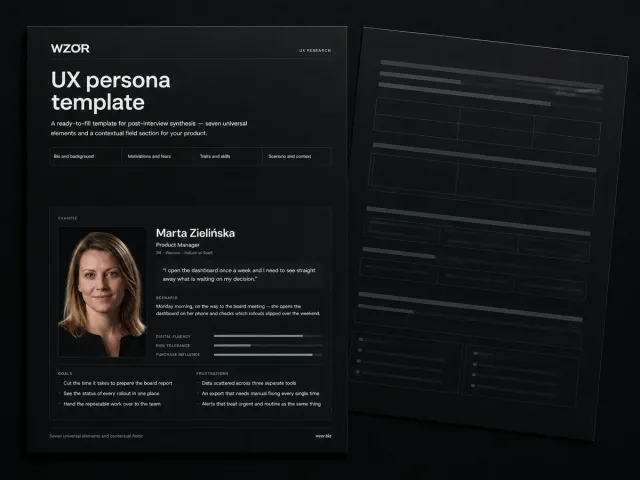
Time to break the persona down into its components. Download the free template I’ve prepared for you. We’ll work on it now.
Download the checklist for free: UX Persona
Free resources
First name
Email address
I confirm that I have read and accept the Personal Data Protection Policy.
Download
A UX persona consists of several universal elements as well as details that refer specifically to your digital product. If you run an online store, you’ll be more interested in your audiences’ income level, whereas if you’re creating the news service mentioned above, you’ll focus rather on the sources of their earnings.
UX persona - universal elements
- A few fictional personal details that make the persona feel real - photo, name, age, gender, marital status, occupation, education.
- Bio/story - the environment the persona operates in, events that influence why they now choose products like yours.
- Skills - proficiency in using the product, usage habits.
- Motivation - the goals, needs, desires and problems that the product helps them satisfy/solve.
- Fears and frustrations - what they don’t like, what frustrates them and what they fear in the context of using your product.
- Personality traits - the persona’s main character traits.
- Product usage scenario - in what situations, places, times, on which devices and in what way does the persona use your product?
UX persona - contextual elements
This is the place for additional information about the persona that’s important in the context of the product you’re creating, e.g.:
- shopping preferences;
- income level;
- interests/hobbies;
- how they spend their free time;
- the values they hold;
- favourite brands;
- the authorities they value;
- the influencers they follow.
How is a UX persona created?
 A UX persona is useful at every stage of work on a digital product
A persona will help you create good UX only when you base it on concrete data, not solely on assumptions. You also have to reckon with the fact that the persona will develop as you gain new information. You’ll verify and refine it. After all, your potential customers’ expectations and technology keep moving forward.
All right, but how do you go about creating the first, baseline version of a UX persona? Filling in the template you downloaded above will require you to go through 4 steps.
Stage 1. Gathering information
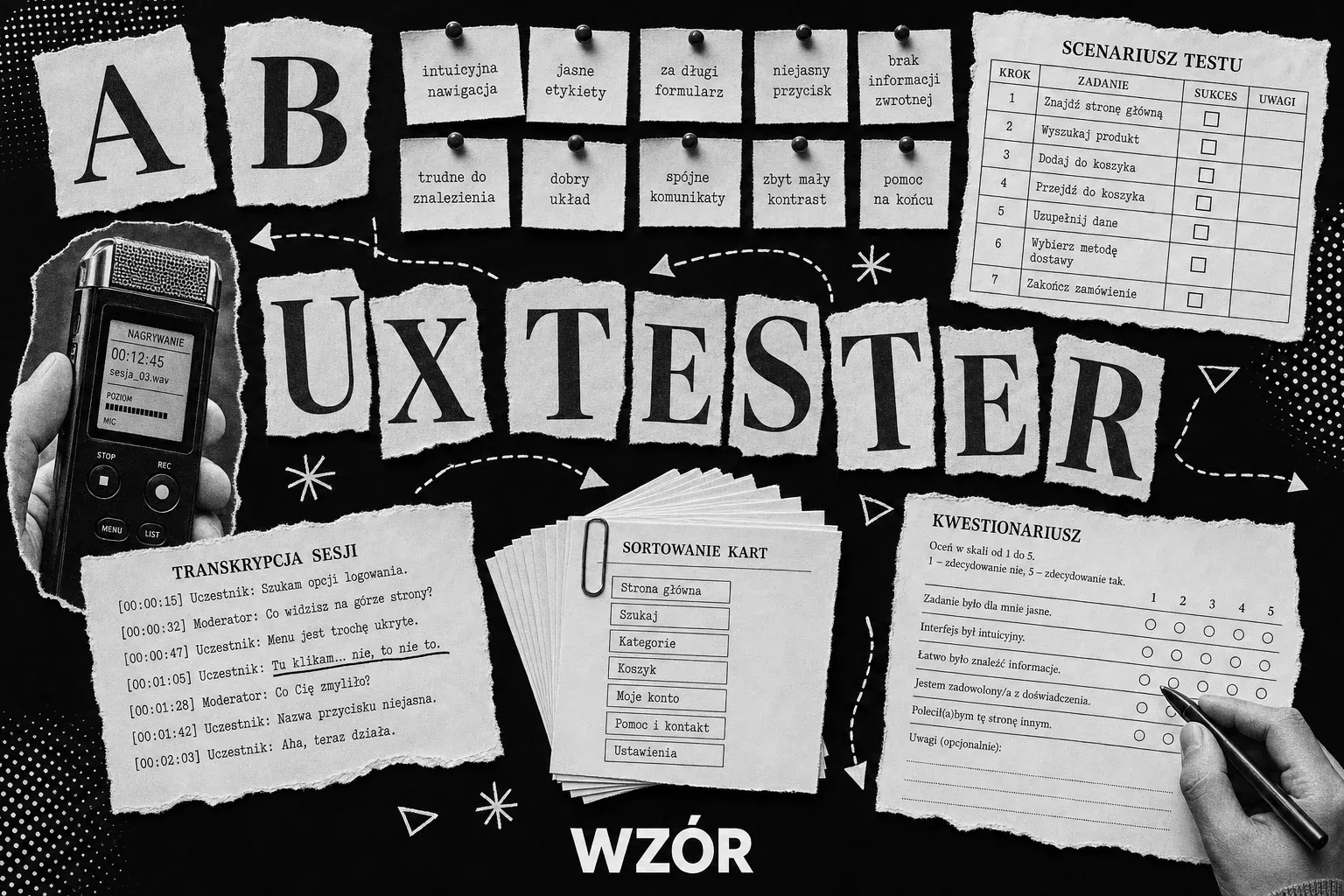
You can draw information about your target users from various sources. UX research will help (in particular in-depth interviews and usability tests), as will surveys, your own observations, statistics available online, and information from customer support.
If the product is already live on the web, use web analytics (e.g. Google Analytics) and session recordings. Likewise, if you already have some information about your customers, e.g. purchase patterns or demographic data, take that into account too.
Stage 2. Interpreting the data
At this stage you analyse the gathered results and identify behaviour patterns. You notice the ways in which users are similar to one another and you create groups. Think of it like folders into which you drop people who are similar in certain respects.
Stage 3. Describing the personas
From each folder, a UX persona will emerge, representing the shared traits of the people the group consists of. How many personas you need depends on the diversity of your potential customers. Some products are niche enough that a single UX persona is sufficient. On the other hand, there are also those suited to almost everyone, and there the personas will be more numerous (the average is 3–4).
If you want to create more personas, remember that this decision must have a solid justification. With so many variables, it’s easy to get lost and lose sight of users’ main needs.
Once you’ve identified your personas, choose one of them as the lead and design especially with them in mind. Take the secondary personas into account too, but to a lesser extent - in line with the principle: “You can’t please everyone”.
Stage 4. Creating documentation
Now you’re ready to complete the whole template. In it you’ll find a section with the product usage scenario. This is the place for a short description of how the persona would reach your digital product and use it to achieve their goals. Thanks to this you’ll understand the main user flows (the paths they take around the product).
When creating the documentation, make sure it’s understandable and readable for everyone involved in creating your digital product. Avoid specialist terms, or explain them if not everyone is as fluent in the topic as you are.
The most common mistakes in the UX persona creation process
- Basing personas solely on your own guesses. That’s a waste of time.
- Creating too many personas. Usually 3–4 UX personas are enough. With too many, they lose their power, because it’s hard to focus on all of them.
- Adding many personal details to personas, e.g. numerous personality elements. A persona is meant to be realistic, but not real. It’s a certain construct that describes a whole group of similar customers.
- Creating descriptions based on general stereotypes that have little to do with the situation of real users.
- Using personas as the only tool for evaluating UX. Unfortunately, it’s not that simple. Besides personas, test your products, analyse them with a User Experience specialist, and track statistics in Google Analytics after launch. Development and optimisation demand it.
Summary
We’ve gone through all the stages from which a UX persona emerges. Time to put this knowledge into practice. Good luck creating your personas!
If you need support with User Experience, take a look at our UX agency.

Senior UX/UI designer at the UX agency Wzór. She designs interfaces for web, mobile and e-commerce applications - from requirements analysis, wireframes and prototypes to final UI consistent with the design system.