Table of Content
Would you like to investigate the usability (UX) of your website or app, but don't know what method to choose? A good number of entrepreneurs and others who are responsible for the success of a digital product are in a similar situation. I'll tell you which usability testing methods are worth considering and what specific information each method will provide you with.
Why test the usability of websites and apps?
Imagine a situation in which you have described your target group at the outset. You defined, according to your gut feeling, their requirements and even researched the competition. You were sure that everything had been done to the last detail. You perfected every CTA button down to the smallest detail. You implemented all the changes that the UX specialist recommended in the expert audit. You implement your digital product and wait impatiently for the first results. You wait, you continue to wait and ... Not much happens.
Traffic pretty good, just the rejection rate some big, and the one from conversions definitely lower than you expected. Why did this happen? On the path from plan to release of the finished product, an important stage was missing - testing.
Fortunately, you are interested in this stage, so you are very likely to avoid this disappointment. Usability testing methods are one of the elements that make digital products ultimately a success rather than a flop, because the developers wanted to hear the voice of the people the product is meant to serve on a daily basis. By doing so, they saved the budget they would have had to spend on implementing flawed solutions. They have also increased their chances of delighting users and keeping them for longer. You want that too, don't you?
What is usability testing?
Usability (UX) research is a way to learn about users, their requirements, experiences and insights. This knowledge can be used to create and develop functional digital products (websites, services, online shops, web and mobile applications) that meet your objectives.
In a nutshell, the usability testing process involves 5 stages:
- Identifying the purpose - what specifically do you need to know at this stage of design?
- Formulating a hypothesis - what do you think you know about this topic, what do you think the answer to the questions posed in point 1 is?
- Choosing a usability testingmethod - which method will answer your questions?
- Conducting userresearch.
- Interpretation of results - what do the figures/qualitative data you obtained tell you?
You can read more about this in the article: Who is a UX tester and how can they support your business?
Effective usability testing methods
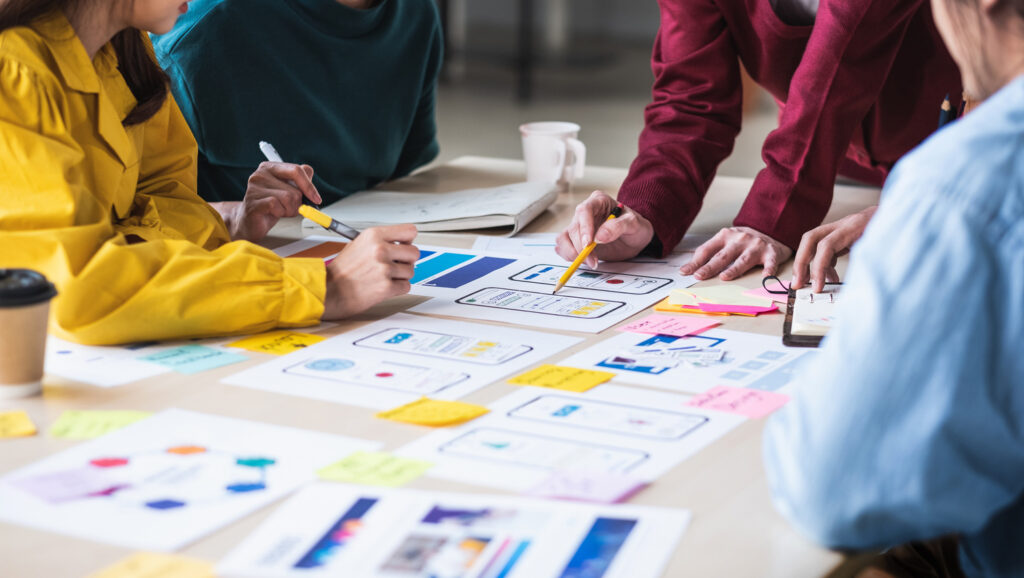
It's time to see which usability research methods are able to give you the data you need. I'll focus on the top 10, in my experience, best types of UX research.
Usability testing (including accessibility testing)
These are the most commonly used usability testing methods - the king of UX testing. Usability tests involve users performing specific tasks on a website, application, online shop or service. Such a task may be finding a product, information, placing an order, getting in touch with a company and many others.
The researcher observes how the person is coping, how much effort it is costing him or her and what paths he or she is taking. Based on this, he or she identifies the needs of the audience, problems with the functionality of the product and opportunities to make the project more effective.
You also need to bear in mind that if you are a public entity, you are required by law to adapt your website and app to the needs of people with disabilities (e.g. visually impaired, hearing impaired).
Prototyping
You will use Protopyp at the design stage and select specific functionalities. Even before you implement them, you can give potential customers a prototype and check whether this form of the product is already good enough and suited to their requirements to allocate a budget for its launch.
Iterative research
Do you dream of usability testing methods that check straight away in the testing phase whether design/production changes work? If so, iterations will appeal to you. They involve testing and solving problems discovered on the fly.
The researcher conducts a first round of tests. On the basis of these, changes are made and, in the second round, the researcher already tests an improved version. How many iterations (rounds of testing) does it take to refine a product? It depends. I know that's not the answer you were hoping for, but it all depends on how complex your project is. Usually 3 rounds are enough.
A/B tests
They allow you to choose the better version of a design, functionality or any other element of your digital product. They allow you to compare the effectiveness and relevance of the two proposals to your users' requirements.
It is best to present the audience with 2 versions that differ in only one element, e.g. colour, content of the button. Otherwise, it will be difficult to determine which specific link decided that a particular proposal was better.
Card sorting
Users are tasked with grouping the cards into categories. Specific topics are placed on the cards. In this way, you can find out the logic guiding your audience. This will make it easier for you to plan your information hierarchy.
If an internet user does not know where to look for specific data, he or she will find it somewhere else, such as a competitor.
Tree test
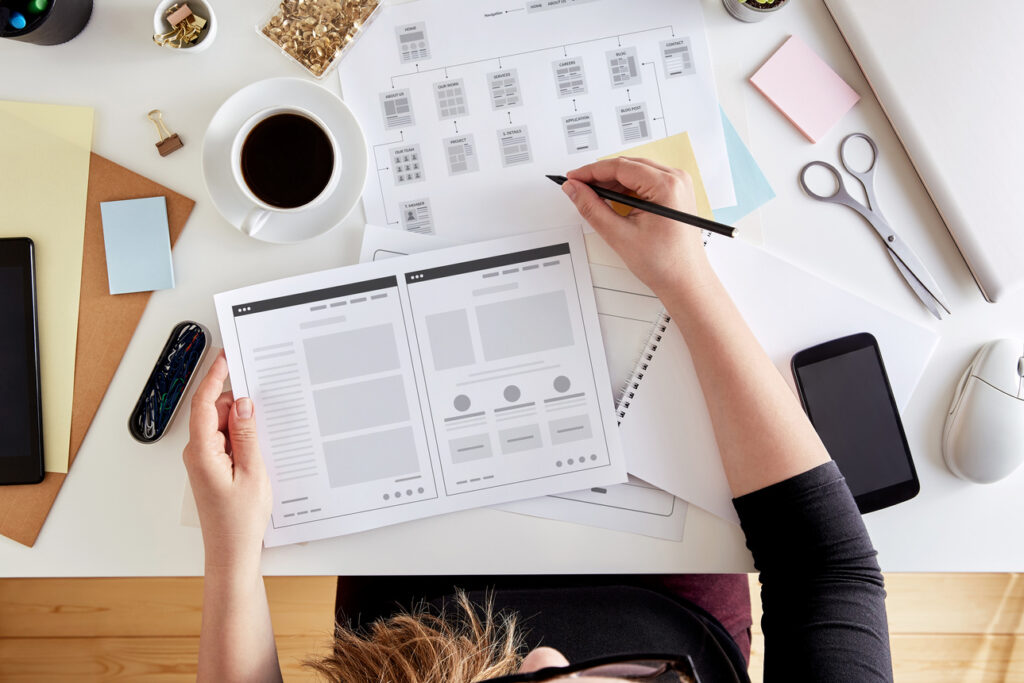
The tree test belongs to the usability testing method of card sorting. In this version, you will check whether the layout of the information and navigation you have planned is actually intuitive for users.
The respondent is given the task of finding a specific piece of information or determining in which of the presented categories he or she would look for it.
5-second test
Although not strictly a usability research method, it can give you an idea of the first impressions that your product evokes in users. The researcher sends them a screen shot of the screen in question, which they have to look at for the eponymous 5 seconds. After this time, the researcher asks questions such as"What element of the page did you like best?","Who do you think this product was created for?","What doyou think thisbrand does?".
How does a 5-second test help you develop your website? In fact, it is the first seconds that are crucial in deciding whether to interact with a page in any way or to leave it. In this context, 5 seconds have power!
Recording of sessions
This method makes it possible to discover how a user behaves on the site under natural conditions. He is not given any task to perform and, unless he reads the privacy policy, he is often not even aware that his session is being recorded (anonymously).
By recording the session , you will see mouse movements, clicks and scrolling, among other things. You will discover where the user gets lost, where they spend the most time and where they decide to end their contact with the product.
The only disadvantage of this method is that it takes a long time to go through the recordings and requires knowledge to interpret them. However, this does not change the fact that you can really extract a lot of information from it.
Heat maps
The maps link directly to the session recording method. They colour-code users' journeys through digital productions. They illustrate the level of their interaction with particular elements of the site, or application.
You will see which places are most visited and which are completely ignored. You will see what is of most interest to your audience and what could be improved.

In-depth interviews with users
The interviews take place 1-on-1. They are conversations moderated by a UX researcher, who first creates an overall plan and the questions he or she should ask the user to verify the hypothesis set at the beginning.
An in-depth interview is more than a simple survey. There are no predetermined, rigid questions. The UX tester follows the interviewee, elaborates on the themes he or she raises and poses open-ended questions. In fact, each interview may start with the same question, but which one ends it depends on the interviewee.
Sounds simple, doesn't it? A simple conversation lasting 1- 1.5 hours. Well, it's not quite like that. The researcher keeps the whole interview within a specific framework. He is constantly striving to provide him with specific information. Interpreting the results also requires a lot of effort on his part, noticing recurring patterns and drawing conclusions. For that, the results themselves are more than once very surprising.
Usability analysis in your company
All right, but how do you know which usability research methods will work best specifically for your company? They all have a lot of very important data to offer, but I realise that you are limited, more or less, by mundane matters such as lack of time, insufficient resources or a budget that forces you to focus only on the most important methods.
Fortunately, you don't have to choose at random. When deciding what to invest in, answer a few questions for yourself.
- At what design stage is your digital product now?
If you are just planning, think about in-depth interviews, card sorting. When testing specific solutions, A/B testing, prototyping, iterative testing, 5-second test can help you. After implementation, think about session recording, usability testing, heat maps. Of course, this is a rather simplified breakdown and other methods can also be useful to you at different stages. My point is just to present the possibilities you have. - What exactly do you want to find out about the usability of your product?
Do you want to test the design for possible bugs? You want to solve a usability problem you already know exists? Do you want to develop your product, add new features? - What kind of data do you need to answer the questions posed?
Do you want to study how users behave when they use your product (quantitative data), or are you more interested in why they do so (qualitative data)? Or are you most interested in their first impressions (5-second test)? - Which method will allow you to achieve more than one objective?
In-depth interviews, for example, are able to provide you with a lot of information about the website that you had no idea about before. It is advisable to choose specific usability research methods taking into account how many questions and hypotheses they are able to validate for you at the same time. - Does your target group know what specifically they might be missing from your product?
If so, in-depth interviews are able to provide you with valuable data. If not, it is true that the moderator is able to guide the conversation in such a way that important issues are uncovered, but it will be far more cost-effective for you to conduct usability tests or map and record the session.
If you need more in-depth information or UX testing support, take a look at our usability research offering. We help you create designs based on evidence - not guesswork.